汨 (mì) means "Mi (name of a river)" in Chinese. It has 7 strokes with the radical 氵.
Rated 3.5/5 in difficulty (challenging).
Appears in 3+ common words including 汨罗江 (mì luó jiāng), 汨水 (mì shuǐ), 汨罗 (mì luó).
Due to its 7 strokes, Hanzi Writer's error detection shows 汨 requires focused practice — most learners need 10+ attempts for consistent accuracy.
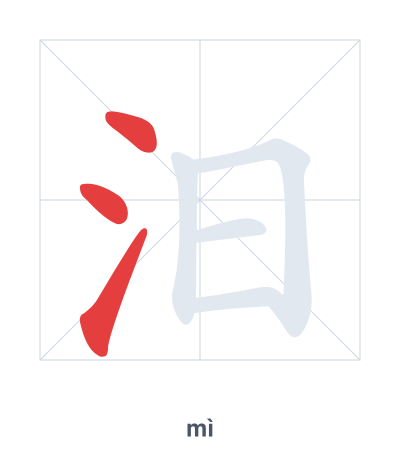
Open Hanzi Writer to see the animated stroke order and practice writing 汨 with real-time feedback.
The character 汨 (mì) is written with 7 strokes. Follow the standard Chinese stroke order: top to bottom, left to right, outside before inside. The radical 氵 is one of its key components.
Practice the correct stroke order with the Hanzi Writer app to see animated stroke-by-stroke guidance with real-time feedback.
汨 means Mi (name of a river).
汨 is a phono-semantic compound combining the water radical 氵 with the component 日 (sun), which historically may have contributed sound or meaning. It specifically refers to the Mi River in Hunan, China, known for its association with the poet Qu Yuan.
💡 Memory Tip: Picture the sun (日) sinking into the water (氵) of the Mi River, creating a bright reflection.
汨罗江在湖南省。
mì luó jiāng zài hú nán shěng
The Miluo River is in Hunan Province.
汨水清澈见底。
mì shuǐ qīng chè jiàn dǐ
The Mi River is crystal clear to the bottom.
他出生在汨罗。
tā chū shēng zài mì luó
He was born in Miluo.
Open Hanzi Writer to see the animated stroke order and practice writing 汨 with real-time feedback.
✨ Animated stroke order · Handwriting recognition · HSK-graded practice · Free to use
汨 is made of the water radical 氵 on the left and 日 (rì, meaning sun) on the right. The water radical indicates it is related to rivers or liquids, while 日 gives the sound mì and is not directly tied to meaning. Together, they form the name of the Mi River.