汐 (xī) means "night tide / ebb tide" in Chinese. It has 6 strokes with the radical 氵.
Rated 3.2/5 in difficulty (challenging).
Appears in 3+ common words including 潮汐 (cháo xī), 汐止 (xī zhǐ), 晚汐 (wǎn xī).
Due to its 6 strokes, Hanzi Writer's error detection shows 汐 requires focused practice — most learners need 10+ attempts for consistent accuracy.
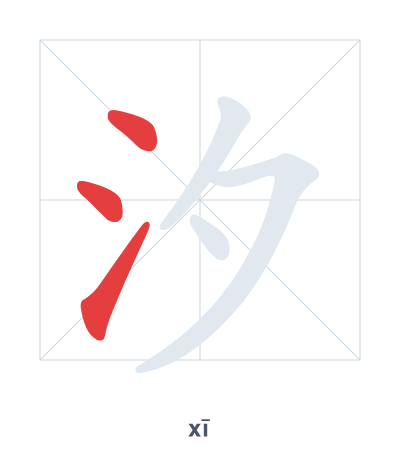
Open Hanzi Writer to see the animated stroke order and practice writing 汐 with real-time feedback.
The character 汐 (xī) is written with 6 strokes. Follow the standard Chinese stroke order: top to bottom, left to right, outside before inside. The radical 氵 is one of its key components.
Practice the correct stroke order with the Hanzi Writer app to see animated stroke-by-stroke guidance with real-time feedback.
汐 means night tide / ebb tide.
汐 combines the water radical 氵 (representing the sea) with 夕 (evening or night), indicating the tide that occurs at night. The character literally means 'night tide' or 'ebb tide,' as the right component 夕 visually depicts a crescent moon, suggesting the time of day when the tide recedes.
💡 Memory Tip: Picture the water (氵) under a crescent moon (夕) slowly pulling back—that's the ebb tide at night.
潮汐有规律。
cháo xī yǒu guī lǜ
Tides are regular.
汐止是一个地方。
xī zhǐ shì yí gè dì fāng
Xizhi is a place.
晚汐非常美丽。
wǎn xī fēi cháng měi lì
The evening tide is very beautiful.
Open Hanzi Writer to see the animated stroke order and practice writing 汐 with real-time feedback.
✨ Animated stroke order · Handwriting recognition · HSK-graded practice · Free to use
汐 is made of the water radical 氵 on the left, and 夕 (xī, meaning 'evening' or 'night') on the right. The combination suggests 'night tide' because the ebb tide often occurs at evening or night.