汔 (qì) means "nearly / almost" in Chinese. It has 6 strokes with the radical 氵.
Rated 3.2/5 in difficulty (challenging).
Appears in 3+ common words including 汔可 (qì kě), 汔用 (qì yòng), 汔济 (qì jì).
Due to its 6 strokes, Hanzi Writer's error detection shows 汔 requires focused practice — most learners need 10+ attempts for consistent accuracy.
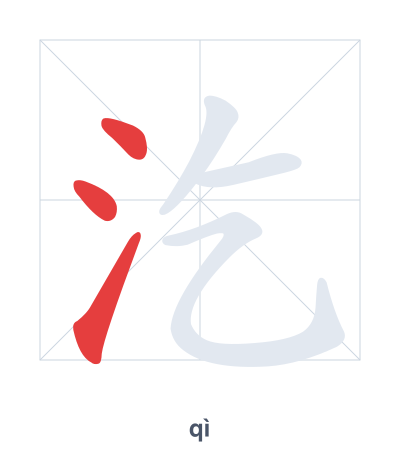
Open Hanzi Writer to see the animated stroke order and practice writing 汔 with real-time feedback.
The character 汔 (qì) is written with 6 strokes. Follow the standard Chinese stroke order: top to bottom, left to right, outside before inside. The radical 氵 is one of its key components.
Practice the correct stroke order with the Hanzi Writer app to see animated stroke-by-stroke guidance with real-time feedback.
汔 means nearly / almost.
This character combines the water radical 氵 (shuǐ) with 乞 (qì), which provides the sound. Originally it described water being exhausted or dried up, and from that sense it extended to mean 'nearly' or 'almost'—as in being on the verge of running out.
💡 Memory Tip: Water (氵) is nearly gone, so you beg (乞) for more before it's all dried up.
汔可小康。
qì kě xiǎo kāng
Almost reaching a state of moderate prosperity.
汔用其力。
qì yòng qí lì
To exert one's strength.
汔济于事。
qì jì yú shì
To be helpful to the matter.
Open Hanzi Writer to see the animated stroke order and practice writing 汔 with real-time feedback.
✨ Animated stroke order · Handwriting recognition · HSK-graded practice · Free to use
The character 汔 is made of the water radical 氵 on the left and 乞 (qǐ, meaning to beg) on the right. The water radical suggests a connection to liquids, while 乞 provides the pronunciation. The meaning "nearly" may come from the idea of water being almost exhausted or a beggar almost out of water.