汀 (tīng) means "Sandbar; islet; beach" in Chinese. It has 5 strokes with the radical 氵.
Rated 2.9/5 in difficulty (moderate).
Appears in 3+ common words including 汀洲 (tīng zhōu), 沙汀 (shā tīng), 绿汀 (lǜ tīng).
Hanzi Writer's stroke validation shows learners typically need 5-8 attempts to write 汀 with correct proportion and order.
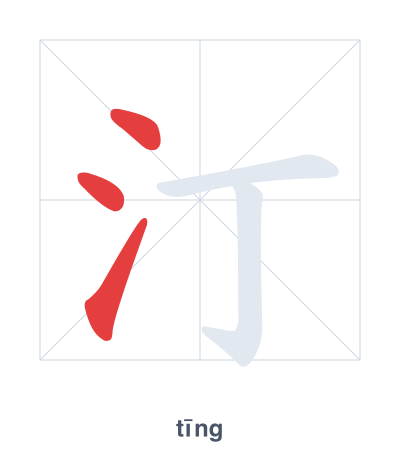
Open Hanzi Writer to see the animated stroke order and practice writing 汀 with real-time feedback.
The character 汀 (tīng) is written with 5 strokes. Follow the standard Chinese stroke order: top to bottom, left to right, outside before inside. The radical 氵 is one of its key components.
Practice the correct stroke order with the Hanzi Writer app to see animated stroke-by-stroke guidance with real-time feedback.
汀 means Sandbar; islet; beach.
汀 is a compound character with water radical 氵 (sān diǎn shuǐ) indicating its connection to water, and the phonetic component 丁 (tīng) which originally meant 'nail' or 'male adult'. Together, they depict a small, firm piece of land (like a nail) standing in water, forming a sandbar or islet.
💡 Memory Tip: Picture water (氵) surrounding a tiny nail-shaped island (丁) — that's the sandbar 汀.
汀洲上有小鸟。
tīng zhōu shàng yǒu xiǎo niǎo
There are small birds on the islet.
湖边有一片沙汀。
hú biān yǒu yī piàn shā tīng
There is a sandbar by the lake.
绿汀草色青青。
lǜ tīng cǎo sè qīng qīng
The grass on the green islet is lush and green.
Open Hanzi Writer to see the animated stroke order and practice writing 汀 with real-time feedback.
✨ Animated stroke order · Handwriting recognition · HSK-graded practice · Free to use
The character 汀 consists of the water radical 氵on the left and 丁 (dīng, meaning 'nail' or 'male adult') on the right. The water radical directly connects to its meaning of a sandbar or islet, which is a landform surrounded by water. The phonetic component 丁 hints at the pronunciation tīng.