奈 (nài) means "how / to deal with" in Chinese. It has 8 strokes with the radical 大, and is HSK Level 5.
Rated 3.7/5 in difficulty (challenging).
Harder than 31% of HSK Level 5 characters.
Appears in 3+ common words including 无奈 (wú nài), 奈何 (nài hé), 怎奈 (zěn nài).
Due to its 8 strokes, Hanzi Writer's error detection shows 奈 requires focused practice — most learners need 10+ attempts for consistent accuracy.
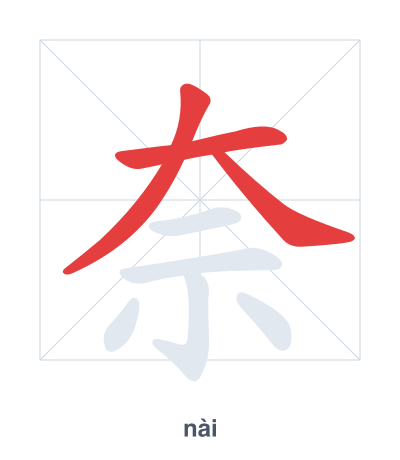
Open Hanzi Writer to see the animated stroke order and practice writing 奈 with real-time feedback.
The character 奈 (nài) is written with 8 strokes. Follow the standard Chinese stroke order: top to bottom, left to right, outside before inside. The radical 大 is one of its key components.
Practice the correct stroke order with the Hanzi Writer app to see animated stroke-by-stroke guidance with real-time feedback.
奈 means how / to deal with.
As an HSK Level 5 character, 奈 is an intermediate-level character.
奈 is a compound character combining 大 (big) and 示 (altar), though its meanings 'how' and 'to deal with' originated from phonetic borrowing rather than its visual components.
💡 Memory Tip: Picture a big (大) altar (示) where you stand puzzled, asking 'How do I deal with this?'
我感到很无奈。
wǒ gǎn dào hěn wú nài
I feel very helpless.
你能奈我何?
nǐ néng nài wǒ hé
What can you do to me?
怎奈天公不作美。
zěn nài tiān gōng bù zuò měi
Unfortunately, the weather didn't cooperate.
Open Hanzi Writer to see the animated stroke order and practice writing 奈 with real-time feedback.
✨ Animated stroke order · Handwriting recognition · HSK-graded practice · Free to use
奈 is made of 大 (big) on top and 示 (to show or indicate) on the bottom. Together they suggest a "big situation being shown" to you, which connects to the meaning of "how to deal with" something. This structure helps you remember that 奈 is used when facing a problem or choice.