夷 (yí) means "to level / smooth / ancient foreign tribes" in Chinese. It has 6 strokes with the radical 大, and is HSK Level 7.
Rated 3.2/5 in difficulty (challenging).
Harder than 9% of HSK Level 7 characters.
Appears in 3+ common words including 化险为夷 (huà xiǎn wéi yí), 夷平 (yí píng), 辛夷 (xīn yí).
Due to its 6 strokes, Hanzi Writer's error detection shows 夷 requires focused practice — most learners need 10+ attempts for consistent accuracy.
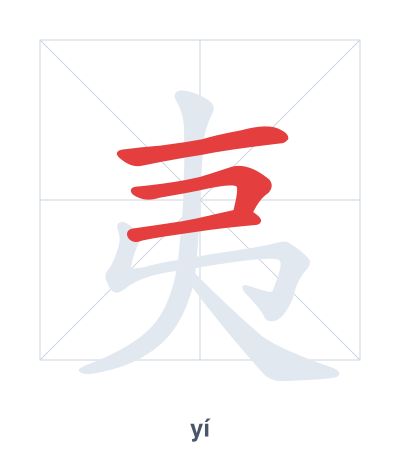
Open Hanzi Writer to see the animated stroke order and practice writing 夷 with real-time feedback.
The character 夷 (yí) is written with 6 strokes. Follow the standard Chinese stroke order: top to bottom, left to right, outside before inside. The radical 大 is one of its key components.
Practice the correct stroke order with the Hanzi Writer app to see animated stroke-by-stroke guidance with real-time feedback.
夷 means to level / smooth / ancient foreign tribes.
As an HSK Level 7 character, 夷 is an intermediate-level character.
The ancient form of 夷 depicts a large person (大) with a bow (弓) tied to their waist, representing a warrior from eastern tribes. Over time, the character came to mean 'to level' or 'smooth,' perhaps from the idea of using a bow to pacify or clear land. The component 大 (big person) shows the human figure, while 弓 (bow) indicates the weapon or tool used for levelling.
💡 Memory Tip: Picture a giant person (大) using a bow (弓) as a giant rake to level the ground, smoothing out the dirt.
我们终于化险为夷了。
wǒ men zhōng yú huà xiǎn wéi yí le
We finally turned danger into safety.
地面被机器夷平了。
dì miàn bèi jī qì yí píng le
The ground was leveled by machines.
辛夷是一种中药。
xīn yí shì yī zhǒng zhōng yào
Xinyi (magnolia flower) is a type of traditional Chinese medicine.
Open Hanzi Writer to see the animated stroke order and practice writing 夷 with real-time feedback.
✨ Animated stroke order · Handwriting recognition · HSK-graded practice · Free to use
The character 夷 consists of 大 (big, person) on top and 弓 (bow) below. Historically, it depicted a person carrying a bow, representing ancient eastern tribes (东夷). This structure also suggests the action of leveling, as a bow could be used to clear or smooth an area.