何 (hé) means "what; how; why" in Chinese. It has 7 strokes with the radical 亻, and is HSK Level 3.
Rated 3.2/5 in difficulty (challenging).
Harder than 27% of HSK Level 3 characters.
Appears in 3+ common words including 任何 (rèn hé), 如何 (rú hé), 几何 (jǐ hé).
Due to its 7 strokes, Hanzi Writer's error detection shows 何 requires focused practice — most learners need 10+ attempts for consistent accuracy.
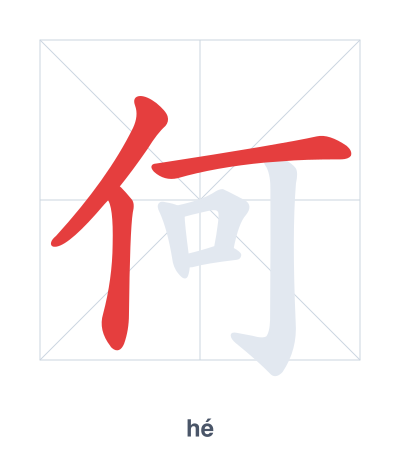
Open Hanzi Writer to see the animated stroke order and practice writing 何 with real-time feedback.
The character 何 (hé) is written with 7 strokes. Follow the standard Chinese stroke order: top to bottom, left to right, outside before inside. The radical 亻 is one of its key components.
Practice the correct stroke order with the Hanzi Writer app to see animated stroke-by-stroke guidance with real-time feedback.
何 means what; how; why.
As an HSK Level 3 character, 何 is an intermediate-level character.
何 combines the person radical 亻 with 可, which originally showed a person carrying a load. The character evolved from meaning 'to bear' to become a general interrogative 'what, how, why' as it was used in questions about carrying or handling things.
💡 Memory Tip: Imagine a person (亻) shrugging and asking 'What?' while pointing at a big 'OK' sign (可) that they can't understand.
没有任何问题。
méi yǒu rèn hé wèn tí
No problem at all.
我们如何去学校?
wǒ men rú hé qù xué xiào
How do we get to school?
他的几何学得很好。
tā de jǐ hé xué dé hěn hǎo
He is very good at geometry.
Open Hanzi Writer to see the animated stroke order and practice writing 何 with real-time feedback.
✨ Animated stroke order · Handwriting recognition · HSK-graded practice · Free to use
何 combines the radical 亻 (person) on the left and 可 (can/possible) on the right. Originally it depicted a person carrying something, but today it is used as a question word meaning "what," "how," or "why." The person radical gives a human context, while 可 adds phonetic and partly semantic value.