夸 (kuā) means "to praise / to exaggerate" in Chinese. It has 6 strokes with the radical 大, and is HSK Level 7.
Rated 3.2/5 in difficulty (challenging).
Harder than 9% of HSK Level 7 characters.
Appears in 3+ common words including 夸奖 (kuā jiǎng), 夸张 (kuā zhāng), 自夸 (zì kuā).
Due to its 6 strokes, Hanzi Writer's error detection shows 夸 requires focused practice — most learners need 10+ attempts for consistent accuracy.
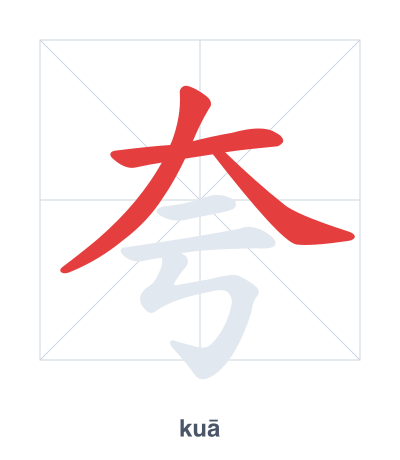
Open Hanzi Writer to see the animated stroke order and practice writing 夸 with real-time feedback.
The character 夸 (kuā) is written with 6 strokes. Follow the standard Chinese stroke order: top to bottom, left to right, outside before inside. The radical 大 is one of its key components.
Practice the correct stroke order with the Hanzi Writer app to see animated stroke-by-stroke guidance with real-time feedback.
夸 means to praise / to exaggerate.
As an HSK Level 7 character, 夸 is an intermediate-level character.
夸 combines the radical 大 (big) with 亏 (deficit), literally showing something made to appear bigger than it is — hence to exaggerate or praise beyond the truth.
💡 Memory Tip: Picture a big (大) person with an enormous curved mouth (like 亏) shouting outsized praise.
老师夸奖了我。
lǎo shī kuā jiǎng le wǒ
The teacher praised me.
这个故事太夸张了。
zhè ge gù shì tài kuā zhāng le
This story is too exaggerated.
他总是在朋友面前自夸。
tā zǒng shì zài péng yǒu miàn qián zì kuā
He is always boasting in front of his friends.
Open Hanzi Writer to see the animated stroke order and practice writing 夸 with real-time feedback.
✨ Animated stroke order · Handwriting recognition · HSK-graded practice · Free to use
夸 combines the radical 大 (big/large) on top and 亏 (kuī, deficit/lack) below. The idea of "big" plus "lack" suggests exaggerating or making something seem bigger than it is, which connects to the meanings of praising or exaggerating.