鸣 (míng) means "To cry / To sing (of birds or insects)" in Chinese. It has 8 strokes with the radical 口, and is HSK Level 7.
Rated 3.7/5 in difficulty (challenging).
Harder than 32% of HSK Level 7 characters.
Appears in 3+ common words including 鸣叫 (míng jiào), 鸣笛 (míng dí), 孤掌难鸣 (gū zhǎng nán míng).
Due to its 8 strokes, Hanzi Writer's error detection shows 鸣 requires focused practice — most learners need 10+ attempts for consistent accuracy.
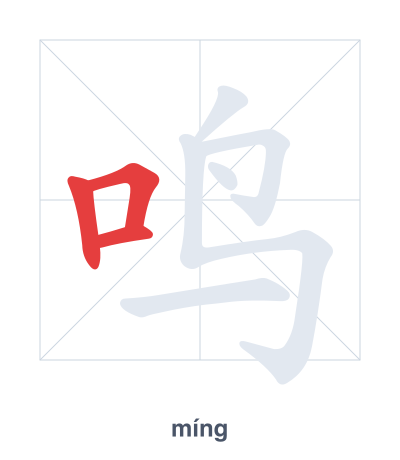
Open Hanzi Writer to see the animated stroke order and practice writing 鸣 with real-time feedback.
The character 鸣 (míng) is written with 8 strokes. Follow the standard Chinese stroke order: top to bottom, left to right, outside before inside. The radical 口 is one of its key components.
Practice the correct stroke order with the Hanzi Writer app to see animated stroke-by-stroke guidance with real-time feedback.
鸣 means To cry / To sing (of birds or insects).
As an HSK Level 7 character, 鸣 is an intermediate-level character.
鸣 combines the radical 口 (mouth) with 鸟 (bird). The character represents a bird opening its mouth to sing or cry, directly linking the visual components to the meaning of bird or insect vocalization.
💡 Memory Tip: Imagine a bird opening its beak (口) to let out a beautiful song, the sound flowing from its mouth into the world.
鸟儿在鸣叫。
niǎo ér zài míng jiào
The bird is singing.
汽车在鸣笛。
qì chē zài míng dí
The car is sounding its horn.
一个人孤掌难鸣。
yí gè rén gū zhǎng nán míng
It's hard to achieve anything alone.
Open Hanzi Writer to see the animated stroke order and practice writing 鸣 with real-time feedback.
✨ Animated stroke order · Handwriting recognition · HSK-graded practice · Free to use
鸣 is made of the radical 口 (mouth) on the left and 鸟 (bird) on the right. The mouth represents sound, and the bird indicates the source, so together they mean the sound a bird makes — to chirp or sing.