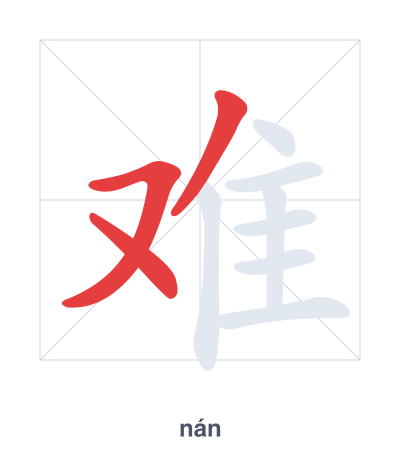
难 (nán) means "difficult; hard" in Chinese. It has 10 strokes with the radical 又, and is HSK Level 1. Difficulty: 3.4/5.
difficult; hard
The character 难 (nán) is written with 10 strokes. Follow the standard Chinese stroke order: top to bottom, left to right, outside before inside. The radical 又 is one of its key components.
Practice the correct stroke order with the Hanzi Writer app to see animated stroke-by-stroke guidance with real-time feedback.
难 is pronounced nán in Mandarin Chinese. It means difficult; hard.
This is a polyphonic character with readings: nán, nàn.
As an HSK Level 1 character, 难 is among the first characters beginners learn.
面对生活中的重重困难,他从未想过放弃。
miàn duì shēng huó zhōng de chóng chóng kùn nán tā cóng wèi xiǎng guò fàng qì
Facing numerous difficulties in life, he never thought of giving up.
难道你真的不知道这件事背后的真相吗?
nán dào nǐ zhēn de bù zhī dào zhè jiàn shì bèi hòu de zhēn xiàng ma
Do you really not know the truth behind this matter?
地震给当地的人民带来了巨大的自然灾难。
dì zhèn gěi dāng dì de rén mín dài lái le jù dà de zì rán zāi nàn
The earthquake brought a massive natural disaster to the local people.
救援人员在废墟中搜寻在那场火灾中罹难的人。
jiù yuán rén yuán zài fèi xū zhōng sōu xún zài nà chǎng huǒ zāi zhōng lí nàn de rén
Rescuers searched the ruins for those who perished in the fire.
Open Hanzi Writer to see the animated stroke order and practice writing 难 with real-time feedback.