掌 (zhǎng) means "palm of the hand" in Chinese. It has 12 strokes with the radical 手, and is HSK Level 5.
Rated 4.2/5 in difficulty (advanced).
Harder than 70% of HSK Level 5 characters.
Appears in 3+ common words including 掌握 (zhǎng wò), 鼓掌 (gǔ zhǎng), 手掌 (shǒu zhǎng).
Due to its 12 strokes, Hanzi Writer's error detection shows 掌 requires focused practice — most learners need 10+ attempts for consistent accuracy.
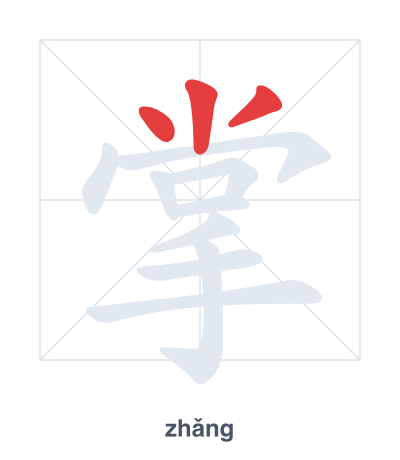
Open Hanzi Writer to see the animated stroke order and practice writing 掌 with real-time feedback.
The character 掌 (zhǎng) is written with 12 strokes. Follow the standard Chinese stroke order: top to bottom, left to right, outside before inside. The radical 手 is one of its key components.
Practice the correct stroke order with the Hanzi Writer app to see animated stroke-by-stroke guidance with real-time feedback.
掌 means palm of the hand.
As an HSK Level 5 character, 掌 is an intermediate-level character.
掌 is a phono-semantic compound: the top part 尚 (shàng) provides the sound, while the bottom 手 (hand) indicates the meaning. The character vividly depicts the palm as a key part of the hand, combining a phonetic cue with the hand radical.
💡 Memory Tip: Imagine your palm is so impressive that you give a 'high five' saying 'Shang!' (尚) while showing your hand (手).
我掌握了汉语语法。
wǒ zhǎng wò le hàn yǔ yǔ fǎ
I've mastered Chinese grammar.
大家为他鼓掌。
dà jiā wèi tā gǔ zhǎng
Everyone clapped for him.
他的手掌很大。
tā de shǒu zhǎng hěn dà
His palms are very large.
Open Hanzi Writer to see the animated stroke order and practice writing 掌 with real-time feedback.
✨ Animated stroke order · Handwriting recognition · HSK-graded practice · Free to use
掌 is made up of two parts: the top part 尚 (shàng, meaning 'still' or 'yet') and the bottom part 手 (shǒu, meaning 'hand'). The radical 手 at the bottom directly shows the hand, and the top part 尚 gives a clue to the pronunciation 'zhǎng'. Together, they form the idea of the palm, the flat part of the hand.