霉 (méi) means "Mold; mildew" in Chinese. It has 15 strokes with the radical 雨, and is HSK Level 7.
Rated 4.2/5 in difficulty (advanced).
Harder than 96% of HSK Level 7 characters.
Appears in 3+ common words including 发霉 (fā méi), 倒霉 (dǎo méi), 霉雨 (méi yǔ).
Due to its 15 strokes, Hanzi Writer's error detection shows 霉 requires focused practice — most learners need 10+ attempts for consistent accuracy.
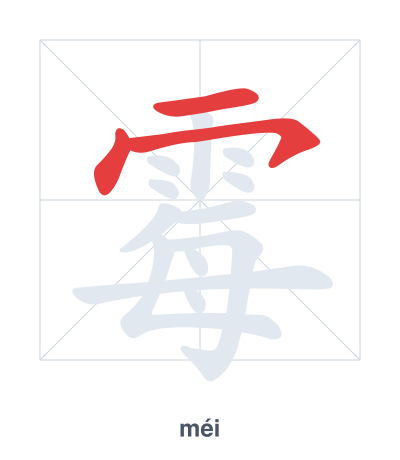
Open Hanzi Writer to see the animated stroke order and practice writing 霉 with real-time feedback.
The character 霉 (méi) is written with 15 strokes. Follow the standard Chinese stroke order: top to bottom, left to right, outside before inside. The radical 雨 is one of its key components.
Practice the correct stroke order with the Hanzi Writer app to see animated stroke-by-stroke guidance with real-time feedback.
霉 means Mold; mildew.
As an HSK Level 7 character, 霉 is an intermediate-level character.
霉 combines 雨 (rain) and 每 (each/every). Rain often brings dampness, and the character suggests that mold appears on 'each' surface exposed to moisture. Historically, the top component signifies the environmental condition (rain/humidity), while the lower part (每) contributes the sound and implies a repetitive, pervasive growth.
💡 Memory Tip: Picture rain (雨) falling on 'every' (每) corner of a dark room, turning the walls green with fuzzy mold.
面包发霉了。
miàn bāo fā méi le
The bread has gone moldy.
我今天真倒霉。
wǒ jīn tiān zhēn dǎo méi
I'm really unlucky today.
霉雨季节很潮湿。
méi yǔ jì jié hěn cháo shī
The plum rain season is very humid.
Open Hanzi Writer to see the animated stroke order and practice writing 霉 with real-time feedback.
✨ Animated stroke order · Handwriting recognition · HSK-graded practice · Free to use
霉 is composed of 雨 (rain) on top and 每 (each/every) below. The rain component suggests moisture, which is necessary for mold to grow. The overall structure indicates that mold appears when there is rain or dampness everywhere.