倒 (dǎo/dào) means "To fall; to pour; conversely; upside down." in Chinese. It has 10 strokes with the radical 亻, and is HSK Level 2.
Rated 3.4/5 in difficulty (challenging).
Harder than 56% of HSK Level 2 characters.
Appears in 4+ common words including 摔倒 (shuāi dǎo), 倒闭 (dǎo bì), 倒影 (dào yǐng).
Due to its 10 strokes, Hanzi Writer's error detection shows 倒 requires focused practice — most learners need 10+ attempts for consistent accuracy.
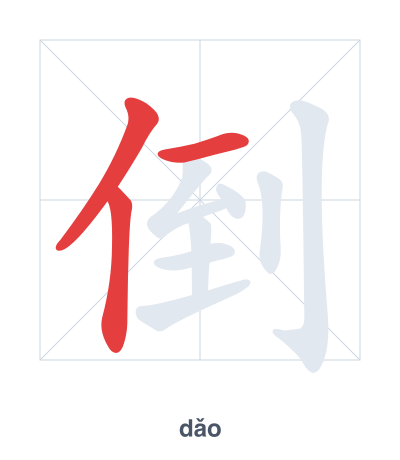
Open Hanzi Writer to see the animated stroke order and practice writing 倒 with real-time feedback.
The character 倒 (dǎo/dào) is written with 10 strokes. Follow the standard Chinese stroke order: top to bottom, left to right, outside before inside. The radical 亻 is one of its key components.
Practice the correct stroke order with the Hanzi Writer app to see animated stroke-by-stroke guidance with real-time feedback.
倒 means To fall; to pour; conversely; upside down..
This is a polyphonic character with readings: dǎo, dào.
As an HSK Level 2 character, 倒 is among the first characters beginners learn.
倒 combines the radical 亻 (person) with 到 (to arrive), suggesting a person arriving and then falling over or being reversed. The character originally depicted a person tipping over, hence meanings like to fall, to pour, or upside down.
💡 Memory Tip: Imagine a person (亻) who arrives (到) at a slippery floor and immediately falls backward (倒).
路上有冰,走路要小心不要摔倒。
lù shàng yǒu bīng zǒu lù yào xiǎo xīn bú yào shuāi dǎo
There is ice on the road; be careful not to slip and fall.
这家商场因为经营不善倒闭了。
zhè jiā shāng chǎng yīn wèi jīng yíng bù shàn dǎo bì le
This shopping mall went out of business due to poor management.
湖面上映射着柳树的倒影。
hú miàn shàng yìng shè zhe liǔ shù de dào yǐng
The reflection of the willow trees is mirrored on the lake surface.
在狭窄的巷子里倒车非常考验技术。
zài xiá zhǎi de xiàng zi lǐ dào chē fēi cháng kǎo yàn jì shù
Reversing a car in a narrow alley is a real test of skill.
Open Hanzi Writer to see the animated stroke order and practice writing 倒 with real-time feedback.
✨ Animated stroke order · Handwriting recognition · HSK-graded practice · Free to use
倒 is made of the radical 亻 (person) on the left and 到 (dào, to arrive) on the right. The person radical suggests a human action, while 到 gives a phonetic clue to the pronunciation. Together, they create the idea of a person arriving and then falling or tipping over.