履 (lǚ) means "shoes; to walk; to fulfill" in Chinese. It has 15 strokes with the radical 尸, and is HSK Level 7.
Rated 4.2/5 in difficulty (advanced).
Harder than 53% of HSK Level 7 characters.
Appears in 3+ common words including 履行 (lǚ xíng), 履历 (lǚ lì), 履约 (lǚ yuē).
Due to its 15 strokes, Hanzi Writer's error detection shows 履 requires focused practice — most learners need 10+ attempts for consistent accuracy.
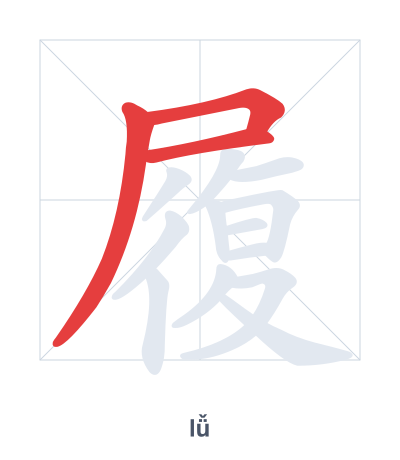
Open Hanzi Writer to see the animated stroke order and practice writing 履 with real-time feedback.
The character 履 (lǚ) is written with 15 strokes. Follow the standard Chinese stroke order: top to bottom, left to right, outside before inside. The radical 尸 is one of its key components.
Practice the correct stroke order with the Hanzi Writer app to see animated stroke-by-stroke guidance with real-time feedback.
履 means shoes; to walk; to fulfill.
As an HSK Level 7 character, 履 is an intermediate-level character.
履's ancient form depicted a person (尸) walking (彳) with a foot (夊) inside a boat-shaped shoe (舟), linking directly to 'shoes' and 'to walk'. Over time, it extended to mean 'to fulfill', as in walking the path of duty.
💡 Memory Tip: Picture a person (尸) stepping (彳) with a foot (夊) into a boat-shaped shoe (舟) to walk and fulfill a promise.
他履行了诺言。
tā lǚ xíng le nuò yán
He kept his promise.
这是他的履历。
zhè shì tā de lǚ lì
This is his resume.
双方按时履约。
shuāng fāng àn shí lǚ yuē
Both parties fulfilled the contract on time.
Open Hanzi Writer to see the animated stroke order and practice writing 履 with real-time feedback.
✨ Animated stroke order · Handwriting recognition · HSK-graded practice · Free to use
The character 履 combines the radical 尸 (body), the left side 彳 (to step), and the right part 复 (again). Together, these components suggest a person stepping repeatedly, which connects to the meanings "to walk" and "to fulfill" an action. The 尸 radical also links to the idea of the body wearing shoes.