尺 (chǐ) means "ruler; a unit of length (chi)" in Chinese. It has 4 strokes with the radical 尸, and is HSK Level 4.
Rated 2.7/5 in difficulty (moderate).
Harder than 6% of HSK Level 4 characters.
Appears in 3+ common words including 尺子 (chǐ zi), 尺寸 (chǐ cùn), 英尺 (yīng chǐ).
Hanzi Writer's stroke validation shows learners typically need 5-8 attempts to write 尺 with correct proportion and order.
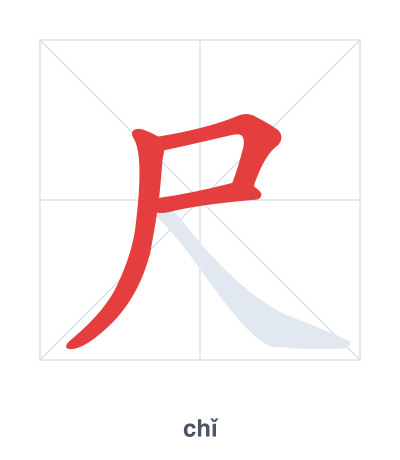
Open Hanzi Writer to see the animated stroke order and practice writing 尺 with real-time feedback.
The character 尺 (chǐ) is written with 4 strokes. Follow the standard Chinese stroke order: top to bottom, left to right, outside before inside. The radical 尸 is one of its key components.
Practice the correct stroke order with the Hanzi Writer app to see animated stroke-by-stroke guidance with real-time feedback.
尺 means ruler; a unit of length (chi).
As an HSK Level 4 character, 尺 is an intermediate-level character.
The character 尺 originally depicted a person's arm with a mark indicating the length from elbow to wrist—an ancient unit of measure. The upper component 尸 represents a human body, while the lower stroke ㇏ signifies the measured distance, showing how the form visually connects to its meaning as a ruler or unit of length.
💡 Memory Tip: Picture a ghostly figure (尸) stretching out its arm with a tiny flag (the last stroke) marking exactly one 尺 (chi) of length.
请借我一把尺子。
qǐng jiè wǒ yī bǎ chǐ zi
Please lend me a ruler.
这件衣服尺寸合适。
zhè jiàn yī fú chǐ cùn hé shì
The size of this garment fits well.
他身高六英尺。
tā shēn gāo liù yīng chǐ
He is six feet tall.
Open Hanzi Writer to see the animated stroke order and practice writing 尺 with real-time feedback.
✨ Animated stroke order · Handwriting recognition · HSK-graded practice · Free to use
The character 尺 consists of the radical 尸 on top, which originally meant a body or person, and a vertical hook stroke at the bottom. This structure is thought to represent a person holding a measuring tool, giving the meaning of a ruler or unit of length.