屦 (jù) means "sandals; straw shoes (archaic)" in Chinese. It has 15 strokes with the radical 尸.
Rated 4.2/5 in difficulty (advanced).
Appears in 3+ common words including 葛屦 (gé jù), 遗屦 (yí jù), 屦校 (jù xiào).
Due to its 15 strokes, Hanzi Writer's error detection shows 屦 requires focused practice — most learners need 10+ attempts for consistent accuracy.
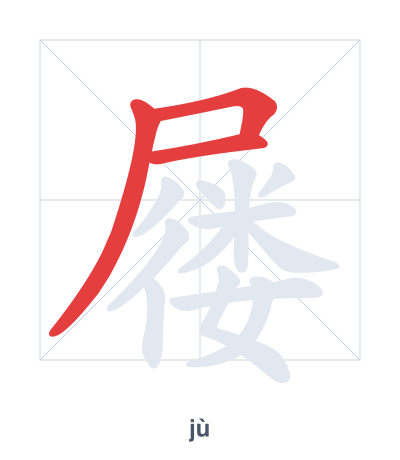
Open Hanzi Writer to see the animated stroke order and practice writing 屦 with real-time feedback.
The character 屦 (jù) is written with 15 strokes. Follow the standard Chinese stroke order: top to bottom, left to right, outside before inside. The radical 尸 is one of its key components.
Practice the correct stroke order with the Hanzi Writer app to see animated stroke-by-stroke guidance with real-time feedback.
屦 means sandals; straw shoes (archaic).
屦 (jù) is a compound character: the radical 尸 represents a body or foot, while 娄 (lóu) provides phonetic hints. In ancient texts, 屦 referred to straw sandals worn on the feet, often associated with humble footwear. The character's structure visually links the body (尸) to the act of wearing shoes, with 娄 contributing the sound.
💡 Memory Tip: Picture a corpse (尸) wearing straw sandals made of rice (米) tied by a woman (女) — a bizarre but memorable scene.
他穿着葛屦。
tā chuān zhe gé jù
He is wearing kudzu-fiber shoes.
地上有一只遗屦。
dì shàng yǒu yī zhī yí jù
There is a lost shoe on the ground.
古人穿屦校。
gǔ rén chuān jù xiào
Ancient people wore shoes and foot shackles (as punishment).
Open Hanzi Writer to see the animated stroke order and practice writing 屦 with real-time feedback.
✨ Animated stroke order · Handwriting recognition · HSK-graded practice · Free to use
屦 is composed of three parts: radical 尸 (corpse/building) on top, 彳 (step) on the left, and 娄 (a phonetic component) on the right. The radical 尸 often relates to body or footwear in ancient characters, and 彳 suggests walking, together indicating something worn on the feet for walking. The phonetic 娄 hints at pronunciation but does not directly contribute to meaning.