行 (háng/xíng) means "To walk / Okay / Row" in Chinese. It has 6 strokes with the radical 行, and is HSK Level 1.
Rated 2/5 in difficulty (beginner-friendly).
Harder than 20% of HSK Level 1 characters.
Appears in 4+ common words including 行走 (xíng zǒu), 行人 (xíng rén), 银行 (yín háng).
In the Hanzi Writer app, most learners master 行 within 3 practice attempts using stroke-by-stroke animation.
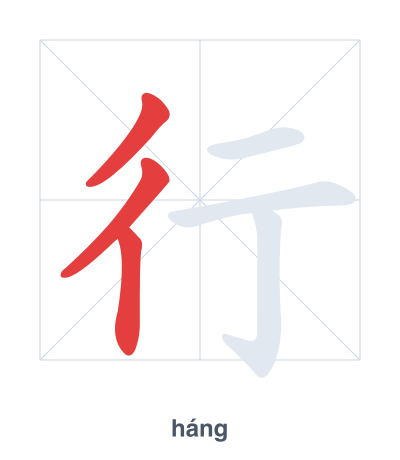
Open Hanzi Writer to see the animated stroke order and practice writing 行 with real-time feedback.
The character 行 (háng/xíng) is written with 6 strokes. Follow the standard Chinese stroke order: top to bottom, left to right, outside before inside. The radical 行 is one of its key components.
Practice the correct stroke order with the Hanzi Writer app to see animated stroke-by-stroke guidance with real-time feedback.
行 means To walk / Okay / Row.
This is a polyphonic character with readings: háng, xíng.
As an HSK Level 1 character, 行 is among the first characters beginners learn.
行 is a pictograph of a crossroads, with the ancient form showing the intersection of two main roads. This image of a crossing or path gave rise to the meanings 'to walk' (moving along a path) and later 'row' (like a line of walkers) and 'okay' (as in 'that path works').
💡 Memory Tip: Imagine a person at a crossroad (行) giving a thumbs up 'okay' while walking in a straight row toward each path.
老人在公园的小路上缓慢行走。
lǎo rén zài gōng yuán de xiǎo lù shàng huǎn màn xíng zǒu
The old man walked slowly on the park path.
街道两旁的行人行色匆匆。
jiē dào liǎng páng de xíng rén xíng sè cōng cōng
Pedestrians on both sides of the street are in a hurry.
他去银行存了一笔钱作为旅行基金。
tā qù yín háng cún le yī bǐ qián zuò wéi lǚ xíng jī jīn
He went to the bank to deposit a sum of money as a travel fund.
互联网是一个发展非常迅速的行业。
hù lián wǎng shì yí gè fā zhǎn fēi cháng xùn sù de háng yè
The internet is a very rapidly developing industry.
Open Hanzi Writer to see the animated stroke order and practice writing 行 with real-time feedback.
✨ Animated stroke order · Handwriting recognition · HSK-graded practice · Free to use
行 is a compound character made of two parts: the left side 彳 (a reduced form of 辵, meaning 'step') and the right side 亍 (also meaning 'step'). Together, they originally depicted a crossroads, which relates to the meaning 'to walk' (xíng). For the pronunciation háng (meaning 'row' or 'bank'), the shape is reused as a phonetic loan with no direct structural connection.