尻 (kāo) means "buttocks; end of the spine" in Chinese. It has 5 strokes with the radical 尸.
Rated 2.9/5 in difficulty (moderate).
Appears in 3+ common words including 尻骨 (kāo gǔ), 尻子 (kāo zi), 尻尖 (kāo jiān).
Hanzi Writer's stroke validation shows learners typically need 5-8 attempts to write 尻 with correct proportion and order.
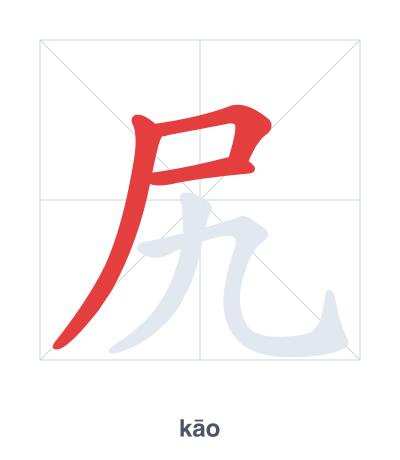
Open Hanzi Writer to see the animated stroke order and practice writing 尻 with real-time feedback.
The character 尻 (kāo) is written with 5 strokes. Follow the standard Chinese stroke order: top to bottom, left to right, outside before inside. The radical 尸 is one of its key components.
Practice the correct stroke order with the Hanzi Writer app to see animated stroke-by-stroke guidance with real-time feedback.
尻 means buttocks; end of the spine.
The character 尻 combines the radical 尸 (representing the body or a corpse) with 九 (nine), which serves as a phonetic component. Its meaning of 'buttocks' or 'end of the spine' relates to the body radical, while 九 may hint at the curved shape of the tailbone area.
💡 Memory Tip: Picture a body (尸) with a curved tailbone shaped like the number 9 (九) at the very end of the spine.
他的尻骨受伤了。
tā de kāo gǔ shòu shāng le
His tailbone is injured.
别打小孩的尻子。
bié dǎ xiǎo hái de kāo zi
Don't spank the child's bottom.
这是猪肉的尻尖。
zhè shì zhū ròu de kāo jiān
This is the pork rump cut.
Open Hanzi Writer to see the animated stroke order and practice writing 尻 with real-time feedback.
✨ Animated stroke order · Handwriting recognition · HSK-graded practice · Free to use
尻 is composed of the radical 尸 (corpse or body) on top, and 九 (nine) underneath. The 尸 radical suggests the body or rear end, while 九 may hint at the coccyx's curved shape. Together, they represent the lower part of the spine or buttocks.