尸 (shī) means "corpse; dead body" in Chinese. It has 3 strokes with the radical 尸, and is HSK Level 7.
Rated 2.2/5 in difficulty (moderate).
Harder than 1% of HSK Level 7 characters.
Appears in 3+ common words including 尸体 (shī tǐ), 僵尸 (jiāng shī), 尸首 (shī shǒu).
Hanzi Writer's stroke validation shows learners typically need 5-8 attempts to write 尸 with correct proportion and order.
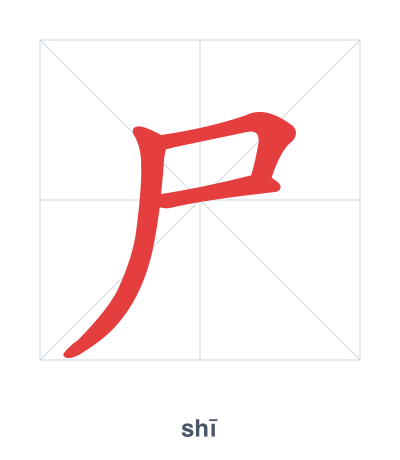
Open Hanzi Writer to see the animated stroke order and practice writing 尸 with real-time feedback.
The character 尸 (shī) is written with 3 strokes. Follow the standard Chinese stroke order: top to bottom, left to right, outside before inside. The radical 尸 is one of its key components.
Practice the correct stroke order with the Hanzi Writer app to see animated stroke-by-stroke guidance with real-time feedback.
尸 means corpse; dead body.
As an HSK Level 7 character, 尸 is an intermediate-level character.
Originally a pictograph of a crouching or seated person, the ancient form of 尸 depicted a figure with bent legs. Over time, its meaning shifted to represent a corpse, as it showed a motionless human body in a reclining posture.
💡 Memory Tip: Imagine a dead body lying flat: the top horizontal is the head, the left vertical is the torso, and the diagonal stroke is a stiff leg sticking out to the left.
医生在检查尸体。
yī shēng zài jiǎn chá shī tǐ
The doctor is examining the corpse.
我喜欢看僵尸电影。
wǒ xǐ huān kàn jiāng shī diàn yǐng
I like watching zombie movies.
警察找到了尸首。
jǐng chá zhǎo dào le shī shǒu
The police found the body.
Open Hanzi Writer to see the animated stroke order and practice writing 尸 with real-time feedback.
✨ Animated stroke order · Handwriting recognition · HSK-graded practice · Free to use
The character 尸 is a pictograph of a bent human body, originally showing a person lying down or squatting. This shape directly represents a corpse or dead body. As a radical, 尸 appears in characters related to the body or death, such as in 尸体 (corpse).