尿 (niào) means "urine; to urinate" in Chinese. It has 7 strokes with the radical 尸, and is HSK Level 7.
Rated 3.5/5 in difficulty (challenging).
Harder than 17% of HSK Level 7 characters.
Appears in 3+ common words including 尿尿 (niào niào), 尿布 (niào bù), 糖尿病 (táng niào bìng).
Due to its 7 strokes, Hanzi Writer's error detection shows 尿 requires focused practice — most learners need 10+ attempts for consistent accuracy.
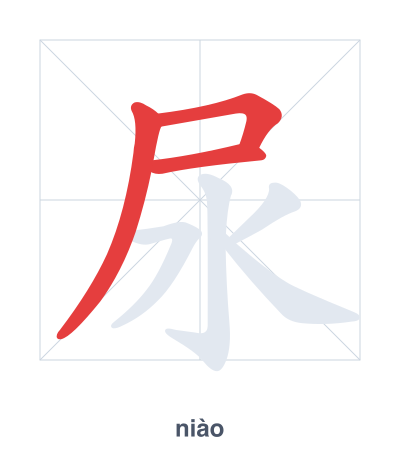
Open Hanzi Writer to see the animated stroke order and practice writing 尿 with real-time feedback.
The character 尿 (niào) is written with 7 strokes. Follow the standard Chinese stroke order: top to bottom, left to right, outside before inside. The radical 尸 is one of its key components.
Practice the correct stroke order with the Hanzi Writer app to see animated stroke-by-stroke guidance with real-time feedback.
尿 means urine; to urinate.
As an HSK Level 7 character, 尿 is an intermediate-level character.
尿 is a compound character: the radical 尸 (body) on top combined with 水 (water) beneath, literally meaning 'water from the body.' Ancient forms depicted a person squatting with streams of water, directly representing urination.
💡 Memory Tip: Imagine a corpse (尸) leaking a puddle of water (水) underneath — that's urine.
小猫在尿尿。
xiǎo māo zài niào niào
The kitten is peeing.
宝宝要换尿布了。
bǎo bǎo yào huàn niào bù le
The baby needs a diaper change.
他有糖尿病。
tā yǒu táng niào bìng
He has diabetes.
Open Hanzi Writer to see the animated stroke order and practice writing 尿 with real-time feedback.
✨ Animated stroke order · Handwriting recognition · HSK-graded practice · Free to use
The character 尿 consists of the radical 尸 (meaning corpse or body) on top and 水 (meaning water) on the bottom. Together, they suggest liquid coming from the body, which directly relates to urine or urinating.