络 (luò) means "Network or net-like." in Chinese. It has 9 strokes with the radical 纟, and is HSK Level 4.
Rated 4/5 in difficulty (challenging).
Harder than 63% of HSK Level 4 characters.
Appears in 3+ common words including 网络 (wǎng luò), 联络 (lián luò), 络绎不绝 (luò yì bù jué).
Due to its 9 strokes, Hanzi Writer's error detection shows 络 requires focused practice — most learners need 10+ attempts for consistent accuracy.
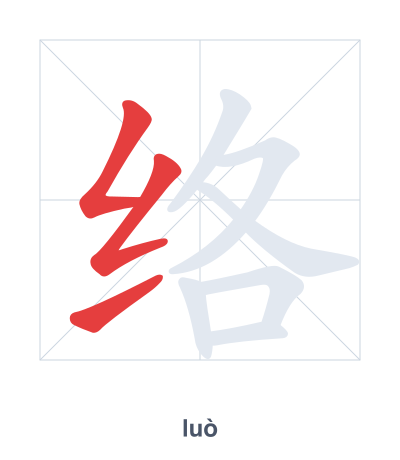
Open Hanzi Writer to see the animated stroke order and practice writing 络 with real-time feedback.
The character 络 (luò) is written with 9 strokes. Follow the standard Chinese stroke order: top to bottom, left to right, outside before inside. The radical 纟 is one of its key components.
Practice the correct stroke order with the Hanzi Writer app to see animated stroke-by-stroke guidance with real-time feedback.
络 means Network or net-like..
As an HSK Level 4 character, 络 is an intermediate-level character.
络 combines the silk radical 纟 (thread) with the phonetic component 各 (luò, 'each'). It originally depicted a net woven from silk threads, later extending to any network-like structure such as veins or communication systems.
💡 Memory Tip: Picture a silk thread (纟) looping around each (各) person's mouth, forming a tangled network.
这里的网络很快。
zhè lǐ de wǎng luò hěn kuài
The internet here is very fast.
我们保持联络。
wǒ men bǎo chí lián luò
Let's keep in touch.
游客络绎不绝。
yóu kè luò yì bù jué
There is an endless stream of tourists.
Open Hanzi Writer to see the animated stroke order and practice writing 络 with real-time feedback.
✨ Animated stroke order · Handwriting recognition · HSK-graded practice · Free to use
络 is composed of the silk radical 纟 on the left and the phonetic component 各 on the right. The silk radical suggests thread or fiber, which is used to make nets, while 各 provides the pronunciation luò. Together they form the meaning of a network or net-like structure.