绝 (jué) means "Absolute, extremely, or to end." in Chinese. It has 9 strokes with the radical 纟, and is HSK Level 3.
Rated 4/5 in difficulty (challenging).
Harder than 67% of HSK Level 3 characters.
Appears in 3+ common words including 绝对 (jué duì), 拒绝 (jù jué), 绝望 (jué wàng).
Due to its 9 strokes, Hanzi Writer's error detection shows 绝 requires focused practice — most learners need 10+ attempts for consistent accuracy.
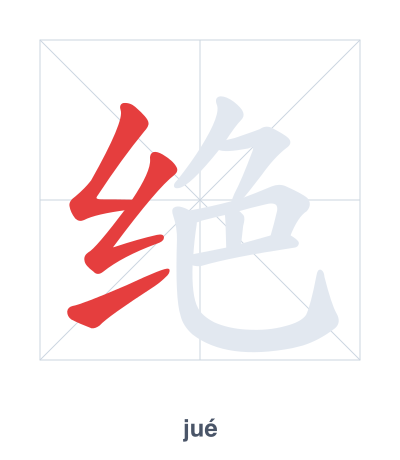
Open Hanzi Writer to see the animated stroke order and practice writing 绝 with real-time feedback.
The character 绝 (jué) is written with 9 strokes. Follow the standard Chinese stroke order: top to bottom, left to right, outside before inside. The radical 纟 is one of its key components.
Practice the correct stroke order with the Hanzi Writer app to see animated stroke-by-stroke guidance with real-time feedback.
绝 means Absolute, extremely, or to end..
As an HSK Level 3 character, 绝 is an intermediate-level character.
The character 绝 combines the silk radical 纟 with a component that originally depicted a knife cutting, symbolizing severing a thread. This act of cutting off represents 'to end,' and by extension, 'absolute' or 'extreme' as in reaching the final point.
💡 Memory Tip: Picture a silk thread (纟) being dyed an absolute, extreme color (色) so vivid that the process ends there.
我绝对支持你。
wǒ jué duì zhī chí nǐ
I absolutely support you.
他拒绝了我的请求。
tā jù jué le wǒ de qǐng qiú
He rejected my request.
请不要感到绝望。
qǐng bú yào gǎn dào jué wàng
Please don't feel hopeless.
Open Hanzi Writer to see the animated stroke order and practice writing 绝 with real-time feedback.
✨ Animated stroke order · Handwriting recognition · HSK-graded practice · Free to use
The character 绝 combines the radical 纟 (silk) on the left with 色 (color, shape) on the right. The silk radical suggests connections or threads, while 色 hints at appearance; together they imply something cut off or final, like a severed thread leading to the meanings of absolute, extreme, or to end.