纯 (chún) means "Pure / Simple" in Chinese. It has 7 strokes with the radical 纟, and is HSK Level 4.
Rated 3.5/5 in difficulty (challenging).
Harder than 35% of HSK Level 4 characters.
Appears in 3+ common words including 纯净水 (chún jìng shuǐ), 单纯 (dān chún), 纯正 (chún zhèng).
Due to its 7 strokes, Hanzi Writer's error detection shows 纯 requires focused practice — most learners need 10+ attempts for consistent accuracy.
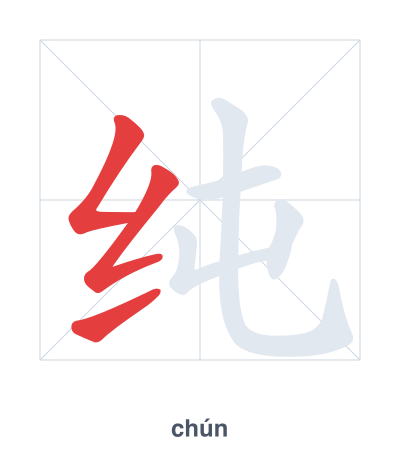
Open Hanzi Writer to see the animated stroke order and practice writing 纯 with real-time feedback.
The character 纯 (chún) is written with 7 strokes. Follow the standard Chinese stroke order: top to bottom, left to right, outside before inside. The radical 纟 is one of its key components.
Practice the correct stroke order with the Hanzi Writer app to see animated stroke-by-stroke guidance with real-time feedback.
纯 means Pure / Simple.
As an HSK Level 4 character, 纯 is an intermediate-level character.
纯 is a phono-semantic compound combining the silk radical (纟) with 屯 (tún), which serves as a phonetic and also hints at 'sprouting' or 'bundled'. Originally it referred to pure, undyed silk—simple and unadorned, just as raw silk is pure before any coloring.
💡 Memory Tip: Imagine a pure white silk thread (纟) carefully tied around a tiny, simple green sprout (屯) to keep it clean and untouched.
我想买一瓶纯净水。
wǒ xiǎng mǎi yī píng chún jìng shuǐ
I want to buy a bottle of purified water.
他的性格很单纯。
tā de xìng gé hěn dān chún
His personality is very simple and innocent.
他的口音非常纯正。
tā de kǒu yīn fēi cháng chún zhèng
His accent is very authentic.
Open Hanzi Writer to see the animated stroke order and practice writing 纯 with real-time feedback.
✨ Animated stroke order · Handwriting recognition · HSK-graded practice · Free to use
The character 纯 combines the silk radical 纟 on the left, which indicates thread or textile, and the phonetic component 屯 on the right. Together they originally referred to pure, unadulterated silk, and now the character means pure, simple, or unblemished.