逻 (luó) means "to patrol" in Chinese. It has 11 strokes with the radical 辶, and is HSK Level 5.
Rated 4.2/5 in difficulty (advanced).
Harder than 95% of HSK Level 5 characters.
Appears in 3+ common words including 逻辑 (luó jí), 巡逻 (xún luó), 逻辑学 (luó jí xué).
Due to its 11 strokes, Hanzi Writer's error detection shows 逻 requires focused practice — most learners need 10+ attempts for consistent accuracy.
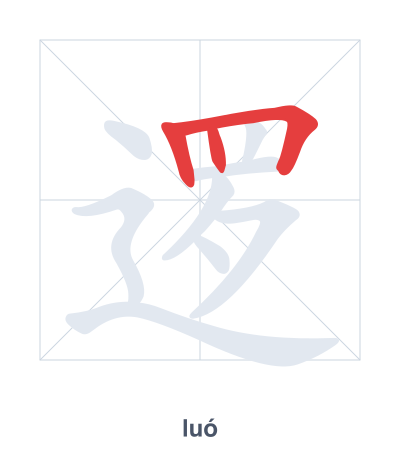
Open Hanzi Writer to see the animated stroke order and practice writing 逻 with real-time feedback.
The character 逻 (luó) is written with 11 strokes. Follow the standard Chinese stroke order: top to bottom, left to right, outside before inside. The radical 辶 is one of its key components.
Practice the correct stroke order with the Hanzi Writer app to see animated stroke-by-stroke guidance with real-time feedback.
逻 means to patrol.
As an HSK Level 5 character, 逻 is an intermediate-level character.
逻 combines the radical 辶 (walk/motion) with 罗 (luó, net), where 罗 originally depicted a bird net. The character suggests patrolling by walking about with a net, implying a watchful search or inspection.
💡 Memory Tip: Picture a patrol officer (辶) sweeping a net (罗) through the streets to catch lawbreakers.
他的逻辑非常清楚。
tā de luó jí fēi cháng qīng chǔ
His logic is very clear.
警察在街上巡逻。
jǐng chá zài jiē shàng xún luó
The police are patrolling the streets.
我正在学习逻辑学。
wǒ zhèng zài xué xí luó jí xué
I am studying logic.
Open Hanzi Writer to see the animated stroke order and practice writing 逻 with real-time feedback.
✨ Animated stroke order · Handwriting recognition · HSK-graded practice · Free to use
逻 is composed of the radical 辶 (walk) on the left and the component 罗 (luó, net) on the right. The 辶 indicates movement or walking, while 罗 suggests covering or searching like a net, so together they create the idea of walking around to patrol. This structural combination directly supports the character's meaning 'to patrol.'