迷 (mí) means "To be lost; fan; enthusiast" in Chinese. It has 9 strokes with the radical 辶, and is HSK Level 3.
Rated 4/5 in difficulty (challenging).
Harder than 69% of HSK Level 3 characters.
Appears in 3+ common words including 迷路 (mí lù), 球迷 (qiú mí), 迷人 (mí rén).
Due to its 9 strokes, Hanzi Writer's error detection shows 迷 requires focused practice — most learners need 10+ attempts for consistent accuracy.
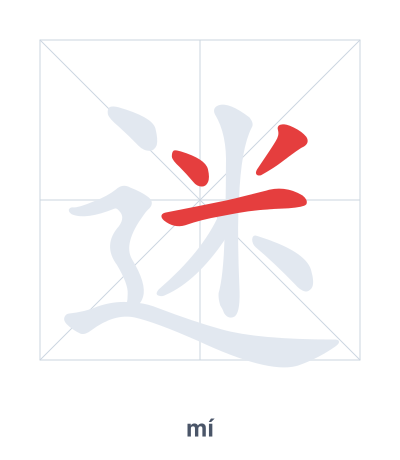
Open Hanzi Writer to see the animated stroke order and practice writing 迷 with real-time feedback.
The character 迷 (mí) is written with 9 strokes. Follow the standard Chinese stroke order: top to bottom, left to right, outside before inside. The radical 辶 is one of its key components.
Practice the correct stroke order with the Hanzi Writer app to see animated stroke-by-stroke guidance with real-time feedback.
迷 means To be lost; fan; enthusiast.
As an HSK Level 3 character, 迷 is an intermediate-level character.
迷 combines 辶 (walking) with 米 (rice), originally depicting someone walking and scattering rice grains, symbolizing losing one's way or becoming confused. The character later extended to mean a fan or enthusiast, as in being 'lost' in a hobby.
💡 Memory Tip: Imagine a rice farmer (米) wandering aimlessly (辶) through his own field, completely lost among the stalks.
我在城市里迷路了。
wǒ zài chéng shì lǐ mí lù le
I got lost in the city.
我哥哥是个足球迷。
wǒ gē gē shì gè zú qiú mí
My older brother is a football fan.
这里的景色非常迷人。
zhè lǐ de jǐng sè fēi cháng mí rén
The scenery here is very enchanting.
Open Hanzi Writer to see the animated stroke order and practice writing 迷 with real-time feedback.
✨ Animated stroke order · Handwriting recognition · HSK-graded practice · Free to use
迷 is made of two parts: the radical 辶 (walk) on the left and the phonetic component 米 (rice) on the right. The radical 辶 suggests movement or walking, which connects to the meaning "to be lost" (as in wandering). The 米 part provides a hint for pronunciation (mǐ) but does not directly relate to the meaning.