忞 (mín) means "To exert oneself" in Chinese. It has 8 strokes with the radical 心.
Rated 3.7/5 in difficulty (challenging).
Appears in 3+ common words including 忞忞 (mín mín), 忞勉 (mín miǎn), 忞志 (mín zhì).
Due to its 8 strokes, Hanzi Writer's error detection shows 忞 requires focused practice — most learners need 10+ attempts for consistent accuracy.
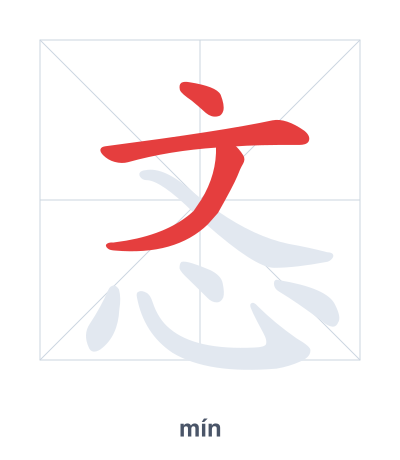
Open Hanzi Writer to see the animated stroke order and practice writing 忞 with real-time feedback.
The character 忞 (mín) is written with 8 strokes. Follow the standard Chinese stroke order: top to bottom, left to right, outside before inside. The radical 心 is one of its key components.
Practice the correct stroke order with the Hanzi Writer app to see animated stroke-by-stroke guidance with real-time feedback.
忞 means To exert oneself.
忞 combines 文 (pattern/culture) above 心 (heart/mind), suggesting the heart/mind applying itself with effort to patterns or learning, hence 'to exert oneself.'
💡 Memory Tip: Imagine writing (文) with all your heart (心) — that concentration and drive is the exertion of 忞.
忞忞而求进。
mín mín ér qiú jìn
Strive diligently for progress.
我们应当忞勉努力。
wǒ men yīng dāng mín miǎn nǔ lì
We should work hard and be diligent.
忞志以自强。
mín zhì yǐ zì qiáng
Strengthen one's will to improve oneself.
Open Hanzi Writer to see the animated stroke order and practice writing 忞 with real-time feedback.
✨ Animated stroke order · Handwriting recognition · HSK-graded practice · Free to use
忞 is made of two parts: 文 (wén, culture or pattern) on top and 心 (xīn, heart or mind) below. The heart represents inner effort, and the culture component suggests that the exertion is related to self-discipline or learning. Together they show a person working hard mentally.