留 (liú) means "To stay, remain, or keep" in Chinese. It has 10 strokes with the radical 田, and is HSK Level 2.
Rated 3.7/5 in difficulty (challenging).
Harder than 86% of HSK Level 2 characters.
Appears in 3+ common words including 留学 (liú xué), 留下 (liú xià), 留言 (liú yán).
Due to its 10 strokes, Hanzi Writer's error detection shows 留 requires focused practice — most learners need 10+ attempts for consistent accuracy.
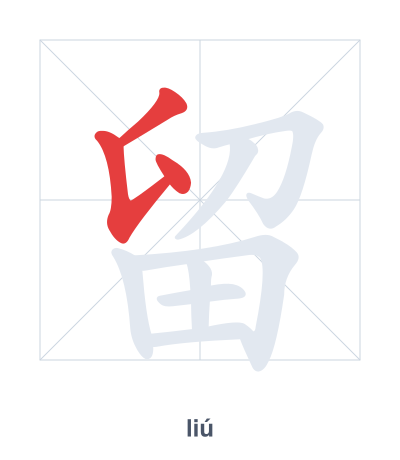
Open Hanzi Writer to see the animated stroke order and practice writing 留 with real-time feedback.
The character 留 (liú) is written with 10 strokes. Follow the standard Chinese stroke order: top to bottom, left to right, outside before inside. The radical 田 is one of its key components.
Practice the correct stroke order with the Hanzi Writer app to see animated stroke-by-stroke guidance with real-time feedback.
留 means To stay, remain, or keep.
As an HSK Level 2 character, 留 is among the first characters beginners learn.
The character 留 combines the radical 田 (field) with 卯, a component that originally depicted a hanging net or hook. The image of a net over a field suggests capturing or holding something in place, thus conveying the meaning 'to stay' or 'to remain.'
💡 Memory Tip: Picture a net (卯) spread over a field (田) to keep the animals from escaping, so they must stay.
我想去中国留学。
wǒ xiǎng qù zhōng guó liú xué
I want to study in China.
请留下你的电话号码。
qǐng liú xià nǐ de diàn huà hào mǎ
Please leave your phone number.
记得在桌上给我留言。
jì de zài zhuō shàng gěi wǒ liú yán
Remember to leave a message for me on the table.
Open Hanzi Writer to see the animated stroke order and practice writing 留 with real-time feedback.
✨ Animated stroke order · Handwriting recognition · HSK-graded practice · Free to use
留 is made of two parts: the top is a variant of 卯 (a hook or something that binds) and the bottom is 田 (field). Together, they suggest the idea of staying in or keeping something in a field, which connects to the meaning 'to stay, remain, or keep.' The 田 radical is a common element in characters related to land or stopping.