阔 (kuò) means "wide; broad; wealthy" in Chinese. It has 12 strokes with the radical 门, and is HSK Level 6.
Rated 4.2/5 in difficulty (advanced).
Harder than 99% of HSK Level 6 characters.
Appears in 3+ common words including 宽阔 (kuān kuò), 阔别 (kuò bié), 阔气 (kuò qì).
Due to its 12 strokes, Hanzi Writer's error detection shows 阔 requires focused practice — most learners need 10+ attempts for consistent accuracy.
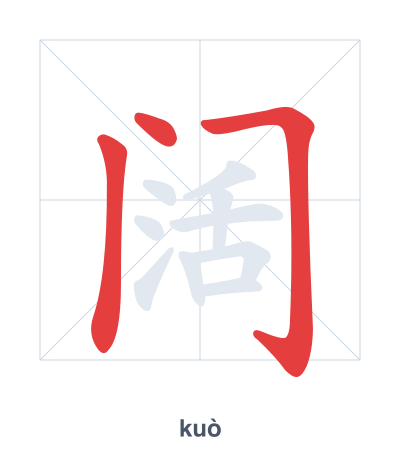
Open Hanzi Writer to see the animated stroke order and practice writing 阔 with real-time feedback.
The character 阔 (kuò) is written with 12 strokes. Follow the standard Chinese stroke order: top to bottom, left to right, outside before inside. The radical 门 is one of its key components.
Practice the correct stroke order with the Hanzi Writer app to see animated stroke-by-stroke guidance with real-time feedback.
阔 means wide; broad; wealthy.
As an HSK Level 6 character, 阔 is an intermediate-level character.
This compound character combines the radical 门 (door/gate) with 活 (lively, active) as a phonetic hint. The door symbolizes an opening or boundary, and the idea of 'liveliness' suggests a spacious, bustling area—hence 'wide, broad,' and by extension 'wealthy' (as in having ample space or resources).
💡 Memory Tip: Picture a wealthy mansion with a wide-open door (门) so grand that a lively (活) party of guests pours through effortlessly.
这条马路很宽阔。
zhè tiáo mǎ lù hěn kuān kuò
This road is very wide.
两人阔别多年。
liǎng rén kuò bié duō nián
The two have been apart for many years.
他出手很阔气。
tā chū shǒu hěn kuò qì
He spends money very generously.
Open Hanzi Writer to see the animated stroke order and practice writing 阔 with real-time feedback.
✨ Animated stroke order · Handwriting recognition · HSK-graded practice · Free to use
The character 阔 is made of the radical 门 (door/gate) on the outside and the phonetic component 活 (alive/lively) inside. This structure suggests a door that is wide open, allowing lively movement, which relates to its meanings of "wide" and "broad."