阄 (jiū) means "Lot (as in drawing lots)" in Chinese. It has 10 strokes with the radical 门.
Rated 4.2/5 in difficulty (advanced).
Appears in 3+ common words including 抓阄 (zhuā jiū), 拈阄 (niān jiū), 阄儿 (jiū er).
Due to its 10 strokes, Hanzi Writer's error detection shows 阄 requires focused practice — most learners need 10+ attempts for consistent accuracy.
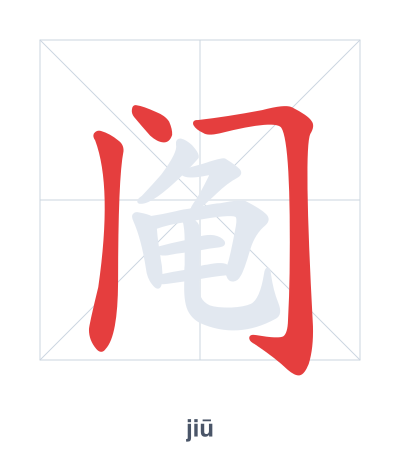
Open Hanzi Writer to see the animated stroke order and practice writing 阄 with real-time feedback.
The character 阄 (jiū) is written with 10 strokes. Follow the standard Chinese stroke order: top to bottom, left to right, outside before inside. The radical 门 is one of its key components.
Practice the correct stroke order with the Hanzi Writer app to see animated stroke-by-stroke guidance with real-time feedback.
阄 means Lot (as in drawing lots).
The character 阄 is a compound of 门 (gate/enclosure) surrounding 龟 (turtle). In ancient China, turtle shells were used for divination and drawing lots, and the enclosure suggests a container from which lots are drawn. The traditional form 鬮 depicted two people (鬥) competing over a turtle (龜), symbolizing the act of selecting a lot by chance.
💡 Memory Tip: Picture a gate with a turtle poking its head out—you have to guess which turtle will be drawn as your lot.
我们抓阄决定吧。
wǒ men zhuā jiū jué dìng ba
Let's draw lots to decide.
大家一起拈阄。
dà jiā yì qǐ niān jiū
Everyone drew lots together.
他拿到了那个阄儿。
tā ná dào le nà ge jiū er
He drew that lot.
Open Hanzi Writer to see the animated stroke order and practice writing 阄 with real-time feedback.
✨ Animated stroke order · Handwriting recognition · HSK-graded practice · Free to use
阄 is made of the radical 门 (door) outside and 龟 (turtle) inside. This is a simplified version of the traditional character 鬮, so the parts do not directly show the meaning of "lot" — it is best to remember it as a fixed combination.