酱 (jiàng) means "sauce or paste" in Chinese. It has 13 strokes with the radical 酉, and is HSK Level 6.
Rated 4.2/5 in difficulty (advanced).
Harder than 95% of HSK Level 6 characters.
Appears in 3+ common words including 果酱 (guǒ jiàng), 酱油 (jiàng yóu), 炸酱面 (zhá jiàng miàn).
Due to its 13 strokes, Hanzi Writer's error detection shows 酱 requires focused practice — most learners need 10+ attempts for consistent accuracy.
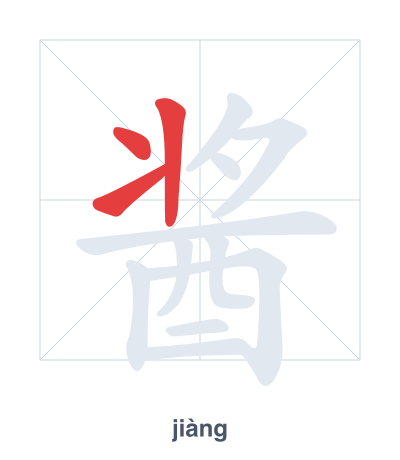
Open Hanzi Writer to see the animated stroke order and practice writing 酱 with real-time feedback.
The character 酱 (jiàng) is written with 13 strokes. Follow the standard Chinese stroke order: top to bottom, left to right, outside before inside. The radical 酉 is one of its key components.
Practice the correct stroke order with the Hanzi Writer app to see animated stroke-by-stroke guidance with real-time feedback.
酱 means sauce or paste.
As an HSK Level 6 character, 酱 is an intermediate-level character.
酱 combines the radical 酉 (wine jar, indicating fermentation) with 爿 (a phonetic component originally meaning 'wooden plank' or 'half-log'), together depicting a fermented condiment made from grains or meat stored in a jar.
💡 Memory Tip: Picture a wine jar (酉) with a wide wooden plank (爿) on top, where rows of sauce bottles are lined up like a pantry shelf.
面包上涂了果酱。
miàn bāo shàng tú le guǒ jiàng
Jam was spread on the bread.
请给我一点酱油。
qǐng gěi wǒ yì diǎn jiàng yóu
Please give me some soy sauce.
我想吃炸酱面。
wǒ xiǎng chī zhá jiàng miàn
I want to eat Zhajiangmian (noodles with soybean paste).
Open Hanzi Writer to see the animated stroke order and practice writing 酱 with real-time feedback.
✨ Animated stroke order · Handwriting recognition · HSK-graded practice · Free to use
The left component is 酉, which originally meant wine or fermented liquid, showing that sauces are often fermented products. The right part is a combination of 匕 (spoon) above 夕 (evening), but this part mainly serves as a phonetic hint. Together, the structure suggests a fermented product that you might scoop with a spoon.