籍 (jí) means "record / register / native place" in Chinese. It has 20 strokes with the radical 竹, and is HSK Level 5.
Rated 4.2/5 in difficulty (advanced).
Harder than 86% of HSK Level 5 characters.
Appears in 3+ common words including 书籍 (shū jí), 国籍 (guó jí), 户籍 (hù jí).
Due to its 20 strokes, Hanzi Writer's error detection shows 籍 requires focused practice — most learners need 10+ attempts for consistent accuracy.
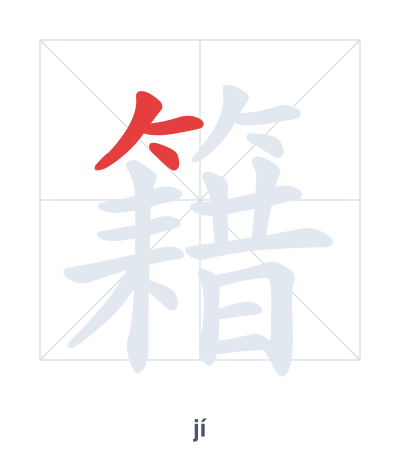
Open Hanzi Writer to see the animated stroke order and practice writing 籍 with real-time feedback.
The character 籍 (jí) is written with 20 strokes. Follow the standard Chinese stroke order: top to bottom, left to right, outside before inside. The radical 竹 is one of its key components.
Practice the correct stroke order with the Hanzi Writer app to see animated stroke-by-stroke guidance with real-time feedback.
籍 means record / register / native place.
As an HSK Level 5 character, 籍 is an intermediate-level character.
The character 籍 combines the bamboo radical 竹 (zhú), representing bamboo slips used for writing in ancient China, with 耤 (jí), which provides the pronunciation and originally referred to plowing or cultivating—evoking the idea of recording agricultural lands or household registries. Together, they form a character meaning a written record, register, or native place, as ancient bamboo books were used to document such information.
💡 Memory Tip: Imagine a bamboo (竹) bookshelf where each book is a heavy register (record), and inside every page is a tiny plow (耤) symbolizing the farmer's land registration.
图书馆里有很多中文书籍。
tú shū guǎn lǐ yǒu hěn duō zhōng wén shū jí
There are many Chinese books in the library.
请在表格上填写你的国籍。
qǐng zài biǎo gé shàng tián xiě nǐ de guó jí
Please fill in your nationality on the form.
他的户籍所在地是北京。
tā de hù jí suǒ zài dì shì běi jīng
His registered residence is in Beijing.
Open Hanzi Writer to see the animated stroke order and practice writing 籍 with real-time feedback.
✨ Animated stroke order · Handwriting recognition · HSK-graded practice · Free to use
The character 籍 consists of the radical 竹 (bamboo) on top and the component 耤 (jí) below. The bamboo radical represents the ancient practice of writing records on bamboo slips. The lower part 耤 gives the sound and also carries the idea of recording land or households, together forming the meaning of a record or register.