簪 (zān) means "hairpin" in Chinese. It has 18 strokes with the radical 竹.
Rated 4.2/5 in difficulty (advanced).
Appears in 3+ common words including 发簪 (fā zān), 玉簪 (yù zān), 簪子 (zān zi).
Due to its 18 strokes, Hanzi Writer's error detection shows 簪 requires focused practice — most learners need 10+ attempts for consistent accuracy.
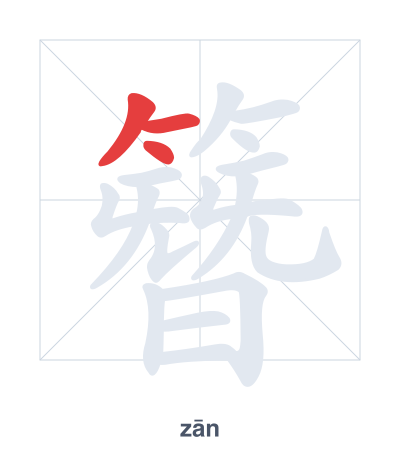
Open Hanzi Writer to see the animated stroke order and practice writing 簪 with real-time feedback.
The character 簪 (zān) is written with 18 strokes. Follow the standard Chinese stroke order: top to bottom, left to right, outside before inside. The radical 竹 is one of its key components.
Practice the correct stroke order with the Hanzi Writer app to see animated stroke-by-stroke guidance with real-time feedback.
簪 means hairpin.
簪 combines the radical 竹 (bamboo, indicating the material) with 朁 (zān), which primarily provides the pronunciation. Ancient hairpins were often made from bamboo, so the bamboo radical connects directly to the object's common material. The lower component 朁 may also suggest the action of inserting or piercing, as it contains elements related to advancing or putting into place.
💡 Memory Tip: Picture a bamboo (竹) hairpin with two prongs (二) and a circular gem (日) at the tip.
她头上戴着一个漂亮的发簪。
tā tóu shàng dài zhe yí gè piào liàng de fā zān
She wore a beautiful hairpin in her hair.
这支玉簪是奶奶送给我的。
zhè zhī yù zān shì nǎi nǎi sòng gěi wǒ de
This jade hairpin was a gift from my grandmother.
古代女子常用簪子固定头发。
gǔ dài nǚ zǐ cháng yòng zān zi gù dìng tóu fà
Ancient women often used hairpins to fix their hair.
Open Hanzi Writer to see the animated stroke order and practice writing 簪 with real-time feedback.
✨ Animated stroke order · Handwriting recognition · HSK-graded practice · Free to use
The character 簪 has the radical 竹 (bamboo) on top, indicating that hairpins were traditionally made from bamboo. The bottom part is a phonetic component that hints at the pronunciation zān, while the overall structure shows a bamboo piece shaped into a decorative hairpin.