巍 (wēi) means "lofty; majestic" in Chinese. It has 20 strokes with the radical 山.
Rated 4.2/5 in difficulty (advanced).
Appears in 3+ common words including 巍峨 (wēi é), 巍然 (wēi rán), 巍巍 (wēi wēi).
Due to its 20 strokes, Hanzi Writer's error detection shows 巍 requires focused practice — most learners need 10+ attempts for consistent accuracy.
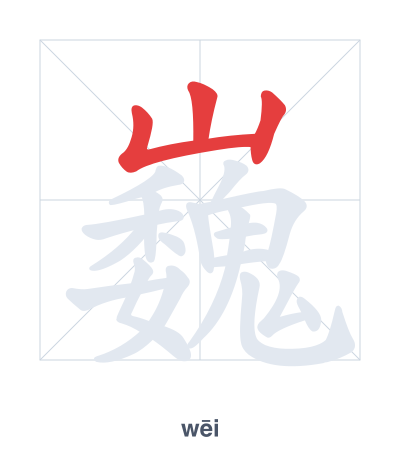
Open Hanzi Writer to see the animated stroke order and practice writing 巍 with real-time feedback.
The character 巍 (wēi) is written with 20 strokes. Follow the standard Chinese stroke order: top to bottom, left to right, outside before inside. The radical 山 is one of its key components.
Practice the correct stroke order with the Hanzi Writer app to see animated stroke-by-stroke guidance with real-time feedback.
巍 means lofty; majestic.
巍 is a phono-semantic compound: the radical 山 (mountain) indicates the meaning, while the lower component 巍 (a combination of 委 'to entrust' and 鬼 'ghost') provides the pronunciation wēi and suggests towering, eerie grandeur. The overall structure evokes a mountain so immense it seems almost supernatural in height.
💡 Memory Tip: Imagine a towering mountain (山) where a ghost (鬼) perches atop a woman (女) holding grain (禾) — all dwarfed by the majestic peak.
巍峨的山峰很高。
wēi é de shān fēng hěn gāo
The majestic peaks are very high.
他巍然不动。
tā wēi rán bù dòng
He stood firm and unshakable.
巍巍群山很美丽。
wēi wēi qún shān hěn měi lì
The majestic mountains are very beautiful.
Open Hanzi Writer to see the animated stroke order and practice writing 巍 with real-time feedback.
✨ Animated stroke order · Handwriting recognition · HSK-graded practice · Free to use
巍 is composed of the radical 山 (mountain) on top, with the lower part containing 嵬 (wéi, high and rugged), which itself includes 鬼 (ghost). The 山 radical directly ties to the meaning of 'lofty' or 'majestic,' as tall mountains inspire awe, while the lower part reinforces the idea of height and imposing presence.