壤 (rǎng) means "soil / earth" in Chinese. It has 20 strokes with the radical 土, and is HSK Level 7.
Rated 3.8/5 in difficulty (challenging).
Harder than 32% of HSK Level 7 characters.
Appears in 3+ common words including 土壤 (tǔ rǎng), 边壤 (biān rǎng), 壤土 (rǎng tǔ).
Due to its 20 strokes, Hanzi Writer's error detection shows 壤 requires focused practice — most learners need 10+ attempts for consistent accuracy.
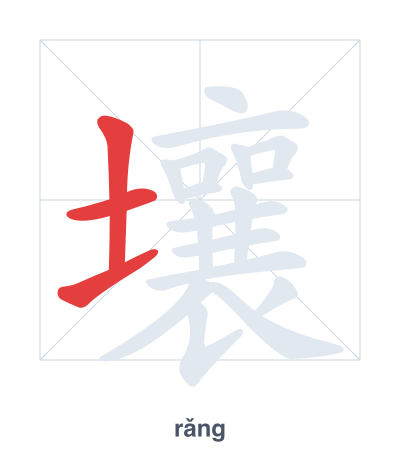
Open Hanzi Writer to see the animated stroke order and practice writing 壤 with real-time feedback.
The character 壤 (rǎng) is written with 20 strokes. Follow the standard Chinese stroke order: top to bottom, left to right, outside before inside. The radical 土 is one of its key components.
Practice the correct stroke order with the Hanzi Writer app to see animated stroke-by-stroke guidance with real-time feedback.
壤 means soil / earth.
As an HSK Level 7 character, 壤 is an intermediate-level character.
壤 is a compound character where the left radical 土 (soil) directly indicates the meaning of earth or soil. The right side 襄 (xiāng) originally provided the pronunciation, and its components — including 衣 (clothing) and forms resembling a mouth and a well — may hint at soil being tilled or carried, referring to soft, fertile soil suitable for farming.
💡 Memory Tip: Imagine soil (土) being wrapped in a coat (衣) that has a well (井) and an open mouth (口) — this strange bundle of fertile earth is 壤.
土壤需要水分。
tǔ rǎng xū yào shuǐ fèn
Soil needs moisture.
两国边壤相接。
liǎng guó biān rǎng xiāng jiē
The two countries share a common border.
这种壤土很松软。
zhè zhǒng rǎng tǔ hěn sōng ruǎn
This loam is very soft and loose.
Open Hanzi Writer to see the animated stroke order and practice writing 壤 with real-time feedback.
✨ Animated stroke order · Handwriting recognition · HSK-graded practice · Free to use
The character 壤 is composed of the radical 土 (earth) on the left and the phonetic component 襄 (xiāng) on the right. The 土 radical directly gives the meaning related to soil, while 襄 adds the sound and also suggests the idea of 'assisting' or 'ample', hinting at fertile, abundant earth.