病 (bìng) means "illness" in Chinese. It has 10 strokes with the radical 疒, and is HSK Level 1.
Rated 3.7/5 in difficulty (challenging).
Harder than 92% of HSK Level 1 characters.
Appears in 3+ common words including 生病 (shēng bìng), 看病 (kàn bìng), 病人 (bìng rén).
Due to its 10 strokes, Hanzi Writer's error detection shows 病 requires focused practice — most learners need 10+ attempts for consistent accuracy.
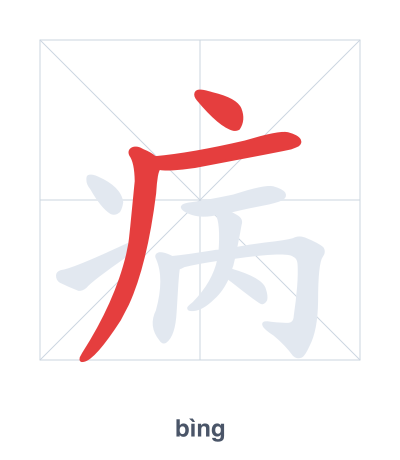
Open Hanzi Writer to see the animated stroke order and practice writing 病 with real-time feedback.
The character 病 (bìng) is written with 10 strokes. Follow the standard Chinese stroke order: top to bottom, left to right, outside before inside. The radical 疒 is one of its key components.
Practice the correct stroke order with the Hanzi Writer app to see animated stroke-by-stroke guidance with real-time feedback.
病 means illness.
As an HSK Level 1 character, 病 is among the first characters beginners learn.
The character 病 combines the radical 疒, a pictograph of a person lying on a bed indicating sickness, with 丙 (bǐng), which provides the sound. Together, they depict someone confined to bed due to illness.
💡 Memory Tip: Picture a sick person (丙) lying on a hospital bed (疒), moaning 'bing-bing' as they suffer from an illness.
他生病了,没去学校。
tā shēng bìng le méi qù xué xiào
He was sick and didn't go to school.
我下午要去医院看病。
wǒ xià wǔ yào qù yī yuàn kàn bìng
I am going to the hospital to see a doctor this afternoon.
医生在给病人检查。
yī shēng zài gěi bìng rén jiǎn chá
The doctor is examining the patient.
Open Hanzi Writer to see the animated stroke order and practice writing 病 with real-time feedback.
✨ Animated stroke order · Handwriting recognition · HSK-graded practice · Free to use
The left part is the radical 疒, which means sickness or disease. The right part is 丙 (bǐng), which gives a hint to the pronunciation but not the meaning. Together, the radical directly shows that the character is about illness.