肌 (jī) means "muscle" in Chinese. It has 6 strokes with the radical 月, and is HSK Level 5.
Rated 3.2/5 in difficulty (challenging).
Harder than 16% of HSK Level 5 characters.
Appears in 3+ common words including 肌肉 (jī ròu), 肌肤 (jī fū), 心肌 (xīn jī).
Due to its 6 strokes, Hanzi Writer's error detection shows 肌 requires focused practice — most learners need 10+ attempts for consistent accuracy.
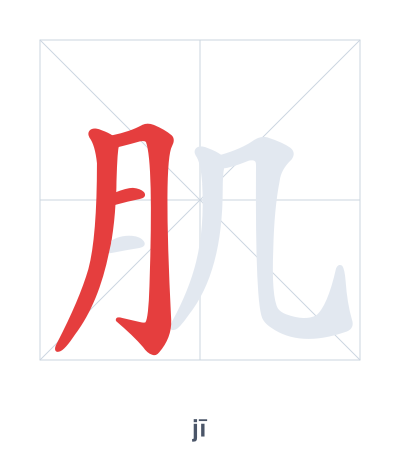
Open Hanzi Writer to see the animated stroke order and practice writing 肌 with real-time feedback.
The character 肌 (jī) is written with 6 strokes. Follow the standard Chinese stroke order: top to bottom, left to right, outside before inside. The radical 月 is one of its key components.
Practice the correct stroke order with the Hanzi Writer app to see animated stroke-by-stroke guidance with real-time feedback.
肌 means muscle.
As an HSK Level 5 character, 肌 is an intermediate-level character.
肌 combines the flesh radical 月 (a variant of 肉, meaning meat/body part) with 几 (jī), which provides the pronunciation. This phono-semantic compound literally means 'flesh of the body' and specifically refers to muscle tissue.
💡 Memory Tip: Imagine a slab of meat (月) placed on a small table (几), and that meat represents the muscles of your body.
他的肌肉很发达。
tā de jī ròu hěn fā dá
His muscles are well-developed.
保护你的肌肤。
bǎo hù nǐ de jī fū
Protect your skin.
心肌很重要。
xīn jī hěn zhòng yào
The heart muscle is very important.
Open Hanzi Writer to see the animated stroke order and practice writing 肌 with real-time feedback.
✨ Animated stroke order · Handwriting recognition · HSK-graded practice · Free to use
The character 肌 consists of the radical 月 (flesh/meat) on the left and 几 (jī, phonetic) on the right. The radical 月 indicates that the meaning relates to body parts or flesh, so 肌 means muscle. The right part 几 provides a pronunciation clue, matching the pinyin jī.