肤 (fū) means "Skin." in Chinese. It has 8 strokes with the radical 月, and is HSK Level 5.
Rated 3.7/5 in difficulty (challenging).
Harder than 38% of HSK Level 5 characters.
Appears in 3+ common words including 皮肤 (pí fū), 肤色 (fū sè), 护肤 (hù fū).
Due to its 8 strokes, Hanzi Writer's error detection shows 肤 requires focused practice — most learners need 10+ attempts for consistent accuracy.
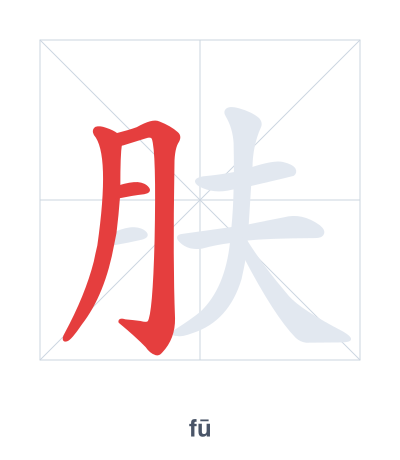
Open Hanzi Writer to see the animated stroke order and practice writing 肤 with real-time feedback.
The character 肤 (fū) is written with 8 strokes. Follow the standard Chinese stroke order: top to bottom, left to right, outside before inside. The radical 月 is one of its key components.
Practice the correct stroke order with the Hanzi Writer app to see animated stroke-by-stroke guidance with real-time feedback.
肤 means Skin..
As an HSK Level 5 character, 肤 is an intermediate-level character.
肤 combines the flesh radical 月 with 夫 (man), literally meaning 'flesh of a man.' In ancient Chinese, the character originally referred to the outer layer of the body—the skin—emphasizing its connection to the physical form.
💡 Memory Tip: A man (夫) wears a fleshy coat (月) over his whole body—that's his skin.
她的皮肤非常好。
tā de pí fū fēi cháng hǎo
Her skin is very good.
每个人的肤色不同。
měi gè rén de fū sè bù tóng
Everyone has a different skin color.
睡前要做好护肤。
shuì qián yào zuò hǎo hù fū
Do your skincare routine before going to bed.
Open Hanzi Writer to see the animated stroke order and practice writing 肤 with real-time feedback.
✨ Animated stroke order · Handwriting recognition · HSK-graded practice · Free to use
肤 consists of the radical 月 (flesh/meat) on the left and 夫 on the right. The 月 component gives the idea of body tissue, and the whole character refers to skin, the outer cover of the body.