挥 (huī) means "wave; wield" in Chinese. It has 9 strokes with the radical 扌, and is HSK Level 4.
Rated 4/5 in difficulty (challenging).
Harder than 59% of HSK Level 4 characters.
Appears in 3+ common words including 挥手 (huī shǒu), 挥动 (huī dòng), 发挥 (fā huī).
Due to its 9 strokes, Hanzi Writer's error detection shows 挥 requires focused practice — most learners need 10+ attempts for consistent accuracy.
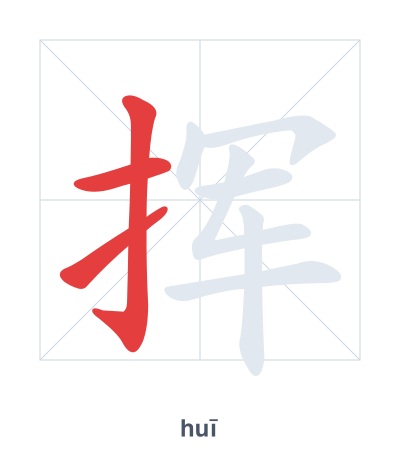
Open Hanzi Writer to see the animated stroke order and practice writing 挥 with real-time feedback.
The character 挥 (huī) is written with 9 strokes. Follow the standard Chinese stroke order: top to bottom, left to right, outside before inside. The radical 扌 is one of its key components.
Practice the correct stroke order with the Hanzi Writer app to see animated stroke-by-stroke guidance with real-time feedback.
挥 means wave; wield.
As an HSK Level 4 character, 挥 is an intermediate-level character.
挥 combines the hand radical 扌 with 军 (army), suggesting the hand's action of waving or wielding something in a military context, like brandishing a weapon or signaling troops.
💡 Memory Tip: A hand (扌) waves a military flag (军) to command the troops.
他向朋友挥手。
tā xiàng péng yǒu huī shǒu
He waved to his friend.
他挥动着旗子。
tā huī dòng zhe qí zi
He is waving a flag.
他的发挥很出色。
tā de fā huī hěn chū sè
His performance was excellent.
Open Hanzi Writer to see the animated stroke order and practice writing 挥 with real-time feedback.
✨ Animated stroke order · Handwriting recognition · HSK-graded practice · Free to use
The character 挥 has two parts: the left side is the radical 扌, which means "hand," and the right side is 军, meaning "army" or "military." The hand radical suggests an action done with the hand, while the military part hints at the idea of waving a flag or wielding a weapon, so together they convey waving or wielding motion.