痪 (huàn) means "paralysis" in Chinese. It has 12 strokes with the radical 疒, and is HSK Level 7.
Rated 4.2/5 in difficulty (advanced).
Harder than 73% of HSK Level 7 characters.
Appears in 3+ common words including 瘫痪 (tān huàn), 交通瘫痪 (jiāo tōng tān huàn), 系统瘫痪 (xì tǒng tān huàn).
Due to its 12 strokes, Hanzi Writer's error detection shows 痪 requires focused practice — most learners need 10+ attempts for consistent accuracy.
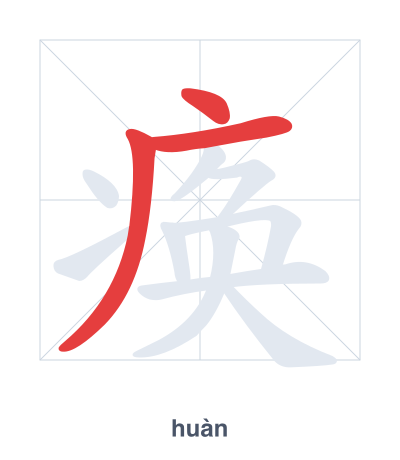
Open Hanzi Writer to see the animated stroke order and practice writing 痪 with real-time feedback.
The character 痪 (huàn) is written with 12 strokes. Follow the standard Chinese stroke order: top to bottom, left to right, outside before inside. The radical 疒 is one of its key components.
Practice the correct stroke order with the Hanzi Writer app to see animated stroke-by-stroke guidance with real-time feedback.
痪 means paralysis.
As an HSK Level 7 character, 痪 is an intermediate-level character.
This character is a phono-semantic compound: the radical 疒 indicates illness or disease, while 奂 (huàn) provides phonetic reinforcement. Paralysis (痪) is a loss of movement caused by a sickness, hence the sickness radical combined with the sound component.
💡 Memory Tip: Imagine a person (大) with limp arms (又) lying on a sickbed (疒) – that's paralysis.
他的双腿瘫痪了。
tā de shuāng tuǐ tān huàn le
His legs are paralyzed.
大雪导致交通瘫痪。
dà xuě dǎo zhì jiāo tōng tān huàn
Heavy snow caused traffic paralysis.
病毒让系统瘫痪了。
bìng dú ràng xì tǒng tān huàn le
The virus paralyzed the system.
Open Hanzi Writer to see the animated stroke order and practice writing 痪 with real-time feedback.
✨ Animated stroke order · Handwriting recognition · HSK-graded practice · Free to use
痪 is made of the radical 疒 (illness) on the left and the phonetic component 奐 on the right. The radical 疒 directly connects to the meaning of paralysis as a sickness or disease. The right part 奐 gives a clue to the pronunciation "huàn" but does not directly relate to meaning.