通 (tōng/tòng) means "To pass through, communicate, or general." in Chinese. It has 10 strokes with the radical 辶, and is HSK Level 2.
Rated 3.7/5 in difficulty (challenging).
Harder than 96% of HSK Level 2 characters.
Appears in 4+ common words including 交通 (jiāo tōng), 通过 (tōng guò), 通知 (tōng zhī).
Due to its 10 strokes, Hanzi Writer's error detection shows 通 requires focused practice — most learners need 10+ attempts for consistent accuracy.
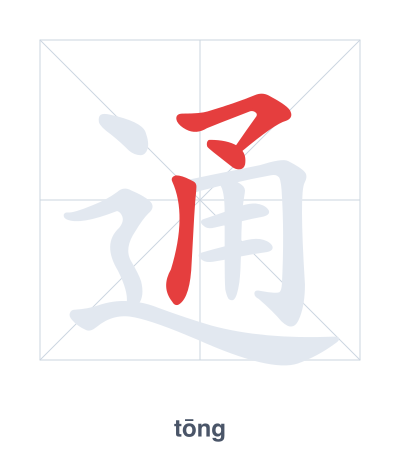
Open Hanzi Writer to see the animated stroke order and practice writing 通 with real-time feedback.
The character 通 (tōng/tòng) is written with 10 strokes. Follow the standard Chinese stroke order: top to bottom, left to right, outside before inside. The radical 辶 is one of its key components.
Practice the correct stroke order with the Hanzi Writer app to see animated stroke-by-stroke guidance with real-time feedback.
通 means To pass through, communicate, or general..
This is a polyphonic character with readings: tōng, tòng.
As an HSK Level 2 character, 通 is among the first characters beginners learn.
通 combines the radical 辶 (walking, movement) with 甬 (yǒng), an ancient pictograph of a bell or a hollow tube, suggesting a passage. Together, they depict moving through a channel or opening, conveying the idea of passing through or communicating.
💡 Memory Tip: Imagine a person (辶) walking through a long tunnel (甬) to reach the other side—that's the way to 'pass through' everything.
这里的交通很方便。
zhè lǐ de jiāo tōng hěn fāng biàn
The transportation here is very convenient.
我通过了汉语考试。
wǒ tōng guò le hàn yǔ kǎo shì
I passed the Chinese exam.
老师发了一个通知。
lǎo shī fā le yí gè tōng zhī
The teacher issued a notice.
他发了一通脾气。
tā fā le yī tòng pí qi
He had a fit of temper.
Open Hanzi Writer to see the animated stroke order and practice writing 通 with real-time feedback.
✨ Animated stroke order · Handwriting recognition · HSK-graded practice · Free to use
通 combines the radical 辶 (walk or move) with the phonetic component 甬 (yǒng, a road or path). The radical suggests movement or passing through, while 甬 reinforces the idea of a passage, together forming the meaning 'to pass through' or 'communicate'.