瘫 (tān) means "paralyzed" in Chinese. It has 15 strokes with the radical 疒, and is HSK Level 7.
Rated 4.2/5 in difficulty (advanced).
Harder than 73% of HSK Level 7 characters.
Appears in 3+ common words including 瘫痪 (tān huàn), 瘫坐 (tān zuò), 软瘫 (ruǎn tān).
Due to its 15 strokes, Hanzi Writer's error detection shows 瘫 requires focused practice — most learners need 10+ attempts for consistent accuracy.
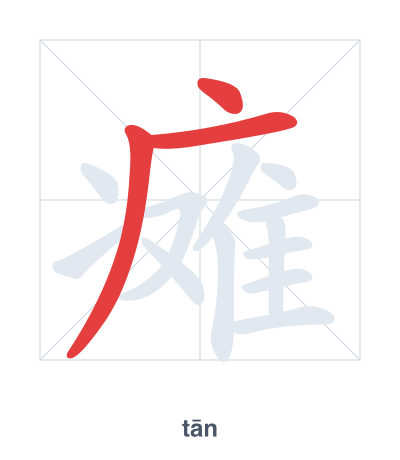
Open Hanzi Writer to see the animated stroke order and practice writing 瘫 with real-time feedback.
The character 瘫 (tān) is written with 15 strokes. Follow the standard Chinese stroke order: top to bottom, left to right, outside before inside. The radical 疒 is one of its key components.
Practice the correct stroke order with the Hanzi Writer app to see animated stroke-by-stroke guidance with real-time feedback.
瘫 means paralyzed.
As an HSK Level 7 character, 瘫 is an intermediate-level character.
瘫 combines the radical 疒 (illness) with 难 (difficult), suggesting a disease that makes movement extremely difficult or impossible. The component 难 also provides a phonetic hint, though the pronunciation shifted slightly.
💡 Memory Tip: Picture a person on a sickbed (疒) with a heavy bird (隹) and a hand (又) pressing them down, leaving them completely paralyzed.
大雪让交通瘫痪了。
dà xuě ràng jiāo tōng tān huàn le
Heavy snow paralyzed the traffic.
他累得瘫坐在地上。
tā lèi dé tān zuò zài dì shàng
He was so tired that he collapsed onto the ground.
他全身软瘫,没有力气。
tā quán shēn ruǎn tān méi yǒu lì qì
His whole body was limp and lacked strength.
Open Hanzi Writer to see the animated stroke order and practice writing 瘫 with real-time feedback.
✨ Animated stroke order · Handwriting recognition · HSK-graded practice · Free to use
瘫 combines the radical 疒 (sickness) with the phonetic component 难 (difficult, nán). The radical suggests a disease or physical condition, while 难 hints that the sickness makes movement very difficult — thus, paralysis.