各 (gè) means "each; every" in Chinese. It has 6 strokes with the radical 口, and is HSK Level 3.
Rated 3.2/5 in difficulty (challenging).
Harder than 28% of HSK Level 3 characters.
Appears in 3+ common words including 各位 (gè wèi), 各个 (gè gè), 各种 (gè zhǒng).
Due to its 6 strokes, Hanzi Writer's error detection shows 各 requires focused practice — most learners need 10+ attempts for consistent accuracy.
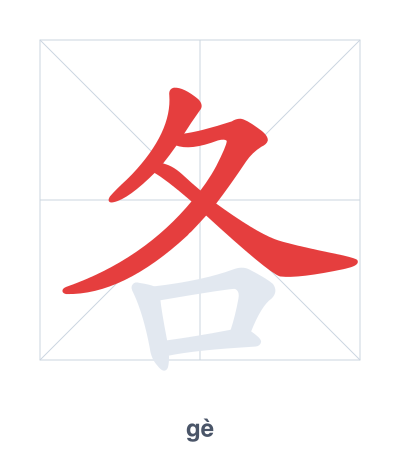
Open Hanzi Writer to see the animated stroke order and practice writing 各 with real-time feedback.
The character 各 (gè) is written with 6 strokes. Follow the standard Chinese stroke order: top to bottom, left to right, outside before inside. The radical 口 is one of its key components.
Practice the correct stroke order with the Hanzi Writer app to see animated stroke-by-stroke guidance with real-time feedback.
各 means each; every.
As an HSK Level 3 character, 各 is an intermediate-level character.
The character 各 combines 夂 (foot, indicating movement) above 口 (mouth or dwelling). Its ancient form depicted a foot arriving at a dwelling, originally meaning 'to come' or 'to arrive.' Over time, it was borrowed phonetically to mean 'each' or 'every,' suggesting individual arrivals at a place.
💡 Memory Tip: Picture each person taking a step (夂) toward a door (口), so that every individual arrives separately.
各位老师好。
gè wèi lǎo shī hǎo
Hello, teachers.
各个地方都不一样。
gè gè dì fāng dōu bù yí yàng
Every place is different.
这里有各种水果。
zhè lǐ yǒu gè zhǒng shuǐ guǒ
There are various fruits here.
Open Hanzi Writer to see the animated stroke order and practice writing 各 with real-time feedback.
✨ Animated stroke order · Handwriting recognition · HSK-graded practice · Free to use
The character 各 is formed from the radical 口 (mouth) on top and 夂 (walk slowly) on the bottom. Originally, it depicted a foot arriving at a mouth, suggesting 'arriving' or 'each' as in 'each person comes.' Today it means 'each; every' and is used to refer to individual items within a group.