位 (wèi) means "position; seat; (classifier for people)" in Chinese. It has 7 strokes with the radical 亻, and is HSK Level 2.
Rated 2.7/5 in difficulty (moderate).
Harder than 25% of HSK Level 2 characters.
Appears in 3+ common words including 哪位 (nǎ wèi), 座位 (zuò wèi), 位子 (wèi zi).
Hanzi Writer's stroke validation shows learners typically need 5-8 attempts to write 位 with correct proportion and order.
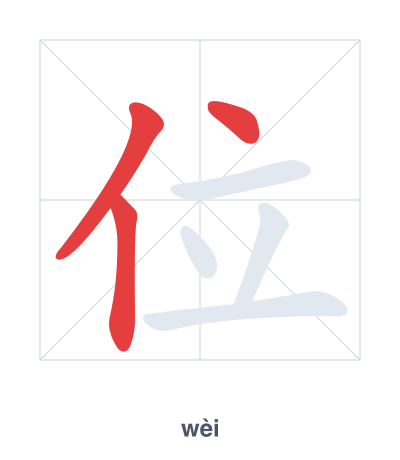
Open Hanzi Writer to see the animated stroke order and practice writing 位 with real-time feedback.
The character 位 (wèi) is written with 7 strokes. Follow the standard Chinese stroke order: top to bottom, left to right, outside before inside. The radical 亻 is one of its key components.
Practice the correct stroke order with the Hanzi Writer app to see animated stroke-by-stroke guidance with real-time feedback.
位 means position; seat; (classifier for people).
As an HSK Level 2 character, 位 is among the first characters beginners learn.
位 combines the human radical 亻 with 立 (to stand), depicting a person standing in a designated spot. Its ancient meaning referred to the position where one stands, later expanding to any seat or rank.
💡 Memory Tip: Picture a polite person (亻) standing upright (立) to reserve your seat (位) at a crowded event.
请问您是哪位?
qǐng wèn nín shì nǎ wèi
May I ask who you are?
这里的座位很多。
zhè lǐ de zuò wèi hěn duō
There are many seats here.
我找到了一个位子。
wǒ zhǎo dào le yí gè wèi zi
I found a seat.
Open Hanzi Writer to see the animated stroke order and practice writing 位 with real-time feedback.
✨ Animated stroke order · Handwriting recognition · HSK-graded practice · Free to use
位 is made of two parts: the radical 亻 (person) on the left, and 立 (lì, meaning 'stand') on the right. Together, they suggest a person standing in a specific place, which developed into the meanings 'position' and 'seat'.