咐 (fù) means "to instruct; to tell" in Chinese. It has 8 strokes with the radical 口, and is HSK Level 7.
Rated 3.7/5 in difficulty (challenging).
Harder than 24% of HSK Level 7 characters.
Appears in 3+ common words including 吩咐 (fēn fù), 嘱咐 (zhǔ fù), 托咐 (tuō fù).
Due to its 8 strokes, Hanzi Writer's error detection shows 咐 requires focused practice — most learners need 10+ attempts for consistent accuracy.
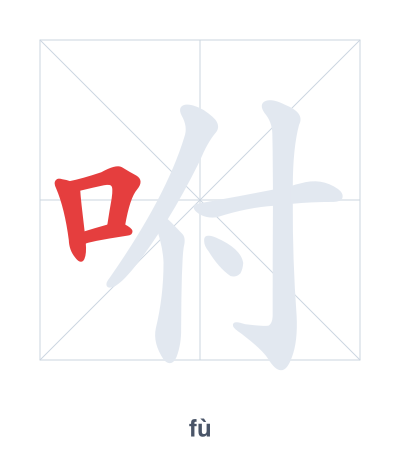
Open Hanzi Writer to see the animated stroke order and practice writing 咐 with real-time feedback.
The character 咐 (fù) is written with 8 strokes. Follow the standard Chinese stroke order: top to bottom, left to right, outside before inside. The radical 口 is one of its key components.
Practice the correct stroke order with the Hanzi Writer app to see animated stroke-by-stroke guidance with real-time feedback.
咐 means to instruct; to tell.
As an HSK Level 7 character, 咐 is an intermediate-level character.
咐 is a compound character combining the radical 口 (mouth) with 付 (fù, meaning 'to give' or 'to hand over'). The mouth radical indicates speech, while 付 adds the sound and suggests the idea of delivering or conveying a message — thus, to instruct or tell someone something through spoken words.
💡 Memory Tip: Picture a person using their mouth (口) to hand over (付) important instructions to someone else.
老师吩咐我早点来。
lǎo shī fēn fù wǒ zǎo diǎn lái
The teacher told me to come early.
妈妈嘱咐我多喝水。
mā mā zhǔ fù wǒ duō hē shuǐ
Mom told me to drink more water.
他托咐我办件事。
tā tuō fù wǒ bàn jiàn shì
He entrusted me with a task.
Open Hanzi Writer to see the animated stroke order and practice writing 咐 with real-time feedback.
✨ Animated stroke order · Handwriting recognition · HSK-graded practice · Free to use
咐 has the radical 口 (mouth) on the left, which indicates speaking, and the phonetic component 付 (fù) on the right. The combination suggests using your mouth to give something — that is, to instruct or tell someone. This structure mirrors the meaning of giving verbal commands.