嘱 (zhǔ) means "to enjoin; to urge; to tell" in Chinese. It has 15 strokes with the radical 口, and is HSK Level 7.
Rated 4.2/5 in difficulty (advanced).
Harder than 49% of HSK Level 7 characters.
Appears in 3+ common words including 嘱咐 (zhǔ fù), 医嘱 (yī zhǔ), 遗嘱 (yí zhǔ).
Due to its 15 strokes, Hanzi Writer's error detection shows 嘱 requires focused practice — most learners need 10+ attempts for consistent accuracy.
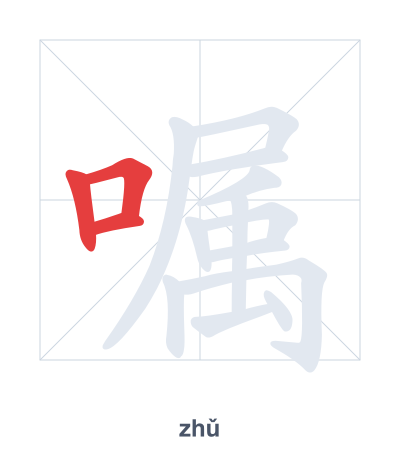
Open Hanzi Writer to see the animated stroke order and practice writing 嘱 with real-time feedback.
The character 嘱 (zhǔ) is written with 15 strokes. Follow the standard Chinese stroke order: top to bottom, left to right, outside before inside. The radical 口 is one of its key components.
Practice the correct stroke order with the Hanzi Writer app to see animated stroke-by-stroke guidance with real-time feedback.
嘱 means to enjoin; to urge; to tell.
As an HSK Level 7 character, 嘱 is an intermediate-level character.
嘱 is a compound character with the mouth radical (口) indicating speech, and the phonetic component 属 (shǔ, meaning 'to belong' or 'category') providing sound. The combination suggests speaking to someone under your authority, urging or instructing them about what belongs to their duty.
💡 Memory Tip: Picture a boss (属) using his mouth (口) to give urgent orders to an employee: 'Do this now!'
妈妈嘱咐我早点回。
mā mā zhǔ fù wǒ zǎo diǎn huí
Mom told me to come back early.
听从医嘱。
tīng cóng yī zhǔ
Follow the doctor's advice.
他写了遗嘱。
tā xiě le yí zhǔ
He wrote a will.
Open Hanzi Writer to see the animated stroke order and practice writing 嘱 with real-time feedback.
✨ Animated stroke order · Handwriting recognition · HSK-graded practice · Free to use
嘱 is composed of the radical 口 (mouth) on the left and 属 (shǔ, to belong or a category) on the right. The mouth component suggests speaking or telling, while 属 provides a phonetic hint and the idea of assigning or directing something to someone. Together, they create the meaning of verbally urging or giving orders.