疯 (fēng) means "mad" in Chinese. It has 9 strokes with the radical 疒, and is HSK Level 5.
Rated 4/5 in difficulty (challenging).
Harder than 54% of HSK Level 5 characters.
Appears in 3+ common words including 疯了 (fēng le), 疯狂 (fēng kuáng), 疯子 (fēng zi).
Due to its 9 strokes, Hanzi Writer's error detection shows 疯 requires focused practice — most learners need 10+ attempts for consistent accuracy.
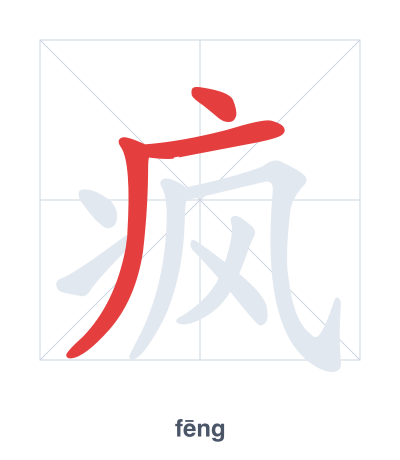
Open Hanzi Writer to see the animated stroke order and practice writing 疯 with real-time feedback.
The character 疯 (fēng) is written with 9 strokes. Follow the standard Chinese stroke order: top to bottom, left to right, outside before inside. The radical 疒 is one of its key components.
Practice the correct stroke order with the Hanzi Writer app to see animated stroke-by-stroke guidance with real-time feedback.
疯 means mad.
As an HSK Level 5 character, 疯 is an intermediate-level character.
疯 is a phono-semantic compound. The radical 疒 (sickness) indicates an illness, while 风 (wind, pronounced fēng) provides both sound and a hint of meaning—madness is like a chaotic, uncontrollable wind blowing through the mind. Together, they suggest a 'wind-sickness' that causes erratic, deranged behavior.
💡 Memory Tip: Imagine a person sick in bed (疒) as a wild wind (风) swirls around their head, literally blowing their sanity away into madness.
你是不是疯了?
nǐ shì bú shì fēng le
Are you crazy?
这是一个疯狂的想法。
zhè shì yí gè fēng kuáng de xiǎng fǎ
This is a crazy idea.
别理那个疯子。
bié lǐ nà ge fēng zi
Ignore that madman.
Open Hanzi Writer to see the animated stroke order and practice writing 疯 with real-time feedback.
✨ Animated stroke order · Handwriting recognition · HSK-graded practice · Free to use
疯 is composed of the radical 疒 (illness) on the outside and 风 (wind) inside. The radical suggests a disease or abnormal condition, while 风 implies something uncontrollable like the wind. Together, they depict a mental illness that causes erratic, wind-like behavior.