Hanzi Writer

How to Write 仿 (fǎng) — Meaning “to imitate / to copy”

fǎng HSK Level 5 6 strokes Radical: 亻

仿 (fǎng) means "to imitate / to copy" in Chinese. It has 6 strokes with the radical 亻, and is HSK Level 5.

Rated 2.9/5 in difficulty (moderate).

Harder than 7% of HSK Level 5 characters.

Appears in 3+ common words including 模仿 (mó fǎng), 仿造 (fǎng zào), 仿佛 (fǎng fú).

Hanzi Writer's stroke validation shows learners typically need 5-8 attempts to write 仿 with correct proportion and order.
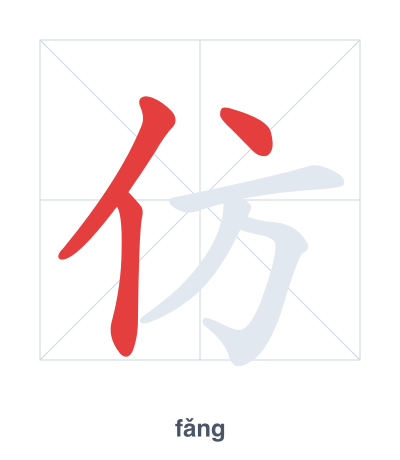
Stroke order practice for 仿 - fǎng

Practice Writing 仿 (fǎng)

Open Hanzi Writer to see the animated stroke order and practice writing 仿 with real-time feedback.

The character 仿 (fǎng) is written with 6 strokes. Follow the standard Chinese stroke order: top to bottom, left to right, outside before inside. The radical is one of its key components.

Practice the correct stroke order with the Hanzi Writer app to see animated stroke-by-stroke guidance with real-time feedback.

仿 means to imitate / to copy.

As an HSK Level 5 character, 仿 is an intermediate-level character.

Character仿
Pinyinfǎng (fang)
Meaningto imitate / to copy
Strokes6
Radical
HSK Level5
Difficulty2.9/5

The character 仿 (fǎng) combines the person radical 亻 (rén, 'person') with 方 (fāng, 'square' or 'direction'). The component 方 provides both phonetic and semantic hints: imitating something means following its direction or pattern, like a person aligning with a model or shape.

💡 Memory Tip: Picture a person (亻) carefully tracing the outline of a square (方) to copy it exactly.

仿 mó fǎng
to imitate; to mimic
仿 fǎng zào
to counterfeit / to copy
仿 fǎng fú
as if / seemingly

他在模仿老师。

tā zài mó fǎng lǎo shī

He is imitating the teacher.

别仿造这个画。

bié fǎng zào zhè ge huà

Don't forge this painting.

他仿佛没听见。

tā fǎng fú méi tīng jiàn

He seemed not to hear.

Character Pinyin Strokes Radical
仿 (current) fǎng 6
shén / shí 4
rén 4
4
Stroke order practice for 仿 - fǎng

Practice Writing 仿 (fǎng)

Open Hanzi Writer to see the animated stroke order and practice writing 仿 with real-time feedback.

✨ Animated stroke order · Handwriting recognition · HSK-graded practice · Free to use

Frequently Asked Questions about 仿

仿 consists of the radical 亻 (person) on the left and 方 (fāng, meaning 'square' or 'direction') on the right. The person radical connects the character to human actions, and 方 provides the pronunciation while suggesting the idea of following a pattern or direction—just as a person imitates a model.

More HSK Level 5 Characters

Characters with Radical 亻

Other 6-Stroke Characters