罚 (fá) means "To punish" in Chinese. It has 9 strokes with the radical 罒, and is HSK Level 5.
Rated 4/5 in difficulty (challenging).
Harder than 56% of HSK Level 5 characters.
Appears in 3+ common words including 罚款 (fá kuǎn), 惩罚 (chéng fá), 罚站 (fá zhàn).
Due to its 9 strokes, Hanzi Writer's error detection shows 罚 requires focused practice — most learners need 10+ attempts for consistent accuracy.
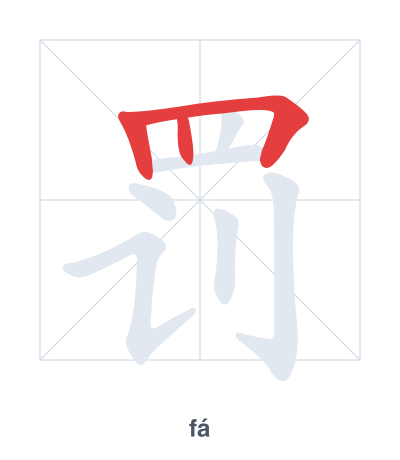
Open Hanzi Writer to see the animated stroke order and practice writing 罚 with real-time feedback.
The character 罚 (fá) is written with 9 strokes. Follow the standard Chinese stroke order: top to bottom, left to right, outside before inside. The radical 罒 is one of its key components.
Practice the correct stroke order with the Hanzi Writer app to see animated stroke-by-stroke guidance with real-time feedback.
罚 means To punish.
As an HSK Level 5 character, 罚 is an intermediate-level character.
罚 combines a net (罒) representing legal authority that traps wrongdoers, with speech (讠) for judgment and a knife (刂) for physical punishment, together symbolizing the imposition of a penalty after a verdict.
💡 Memory Tip: Imagine a net (罒) dropping on a thief as a judge speaks (讠) and a knife (刂) appears to enforce the punishment.
他交了罚款。
tā jiāo le fá kuǎn
He paid the fine.
坏人受到惩罚。
huài rén shòu dào chéng fá
Bad people are punished.
老师让他罚站。
lǎo shī ràng tā fá zhàn
The teacher made him stand as a punishment.
Open Hanzi Writer to see the animated stroke order and practice writing 罚 with real-time feedback.
✨ Animated stroke order · Handwriting recognition · HSK-graded practice · Free to use
罚 is made of three parts: the top 罒 (net), the left 讠 (words), and the right 刂 (knife). Together they suggest the idea of catching someone with words (judgment) and then applying a penalty, like a fine or physical punishment.