罟 (gǔ) means "Fishing net" in Chinese. It has 10 strokes with the radical 罒.
Rated 4.2/5 in difficulty (advanced).
Appears in 3+ common words including 罟网 (gǔ wǎng), 渔罟 (yú gǔ), 罟师 (gǔ shī).
Due to its 10 strokes, Hanzi Writer's error detection shows 罟 requires focused practice — most learners need 10+ attempts for consistent accuracy.
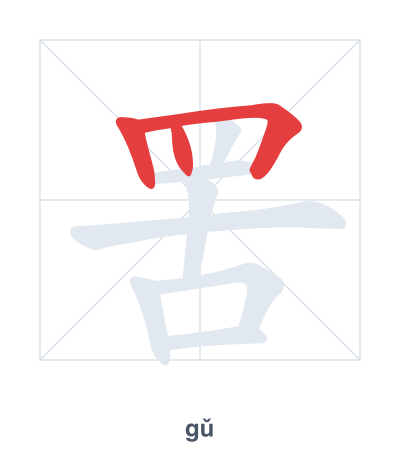
Open Hanzi Writer to see the animated stroke order and practice writing 罟 with real-time feedback.
The character 罟 (gǔ) is written with 10 strokes. Follow the standard Chinese stroke order: top to bottom, left to right, outside before inside. The radical 罒 is one of its key components.
Practice the correct stroke order with the Hanzi Writer app to see animated stroke-by-stroke guidance with real-time feedback.
罟 means Fishing net.
| Character | 罟 |
| Pinyin | gǔ (gu) |
| Meaning | Fishing net |
| Strokes | 10 |
| Radical | 罒 |
| Difficulty | 4.2/5 |
The character 罟 combines the net radical 罒 (a pictograph of a net) with 古 (gǔ, meaning 'ancient') as a phonetic component, indicating a type of fishing net that has been used since ancient times.
💡 Memory Tip: Picture an ancient (古) net (罒) being thrown into a lake to catch fish.
渔民在补罟网。
yú mín zài bǔ gǔ wǎng
The fisherman is mending the fishing net.
他拿着渔罟。
tā ná zhe yú gǔ
He was holding a fishing net.
罟师在船上。
gǔ shī zài chuán shàng
The fisherman is on the boat.
Open Hanzi Writer to see the animated stroke order and practice writing 罟 with real-time feedback.
✨ Animated stroke order · Handwriting recognition · HSK-graded practice · Free to use
罟 is composed of the radical 罒 (net) on top and 古 (gǔ, ancient) below. The top part suggests a net, while 古 provides pronunciation and adds a sense of "old" or "traditional" net. Together, they form a character meaning a fishing net.