Hanzi Writer

How to Write 罔 (wǎng) — Meaning “Net / Deceive”

wǎng 8 strokes Radical: 罒

罔 (wǎng) means "Net / Deceive" in Chinese. It has 8 strokes with the radical 罒.

Rated 3.7/5 in difficulty (challenging).

Appears in 3+ common words including 罔顾 (wǎng gù), 欺罔 (qī wǎng), 迷罔 (mí wǎng).

Due to its 8 strokes, Hanzi Writer's error detection shows 罔 requires focused practice — most learners need 10+ attempts for consistent accuracy.
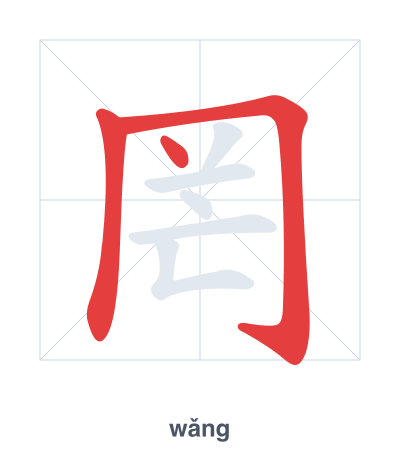
Stroke order practice for 罔 - wǎng

Practice Writing 罔 (wǎng)

Open Hanzi Writer to see the animated stroke order and practice writing 罔 with real-time feedback.

The character (wǎng) is written with 8 strokes. Follow the standard Chinese stroke order: top to bottom, left to right, outside before inside. The radical is one of its key components.

Practice the correct stroke order with the Hanzi Writer app to see animated stroke-by-stroke guidance with real-time feedback.

means Net / Deceive.

Character
Pinyinwǎng (wang)
MeaningNet / Deceive
Strokes8
Radical
Difficulty3.7/5

The character 罔 combines the net radical 罒 (a variant of 网) with the phonetic component 亡 (wáng, meaning 'perish'). Its original meaning is a net for catching fish or birds, which later extended to the concept of ensnaring or deceiving someone, as a net traps its prey.

💡 Memory Tip: Picture a net (罒) that causes you to perish (亡) by trapping you in a deadly deception.

wǎng gù
To disregard
qī wǎng
to deceive; to hoodwink
mí wǎng
Confused; deceived

他罔顾事实。

tā wǎng gù shì shí

He disregarded the facts.

这种行为是欺罔。

zhè zhǒng xíng wéi shì qī wǎng

This behavior is a form of deception.

他的眼神很迷罔。

tā de yǎn shén hěn mí wǎng

His gaze is very dazed.

Character Pinyin Strokes Radical
(current) wǎng 8
hǎn 7
luó 8
9
Stroke order practice for 罔 - wǎng

Practice Writing 罔 (wǎng)

Open Hanzi Writer to see the animated stroke order and practice writing 罔 with real-time feedback.

✨ Animated stroke order · Handwriting recognition · HSK-graded practice · Free to use

Frequently Asked Questions about 罔

The character 罔 is composed of the radical 罒 (net radical) on top, and 亡 (wáng, meaning die or lose) below. The net radical suggests a covering or trapping, while 亡 implies loss or absence, together conveying the idea of being caught in a net or deceived—both meanings of 罔.

Characters with Radical 罒

Other 8-Stroke Characters